
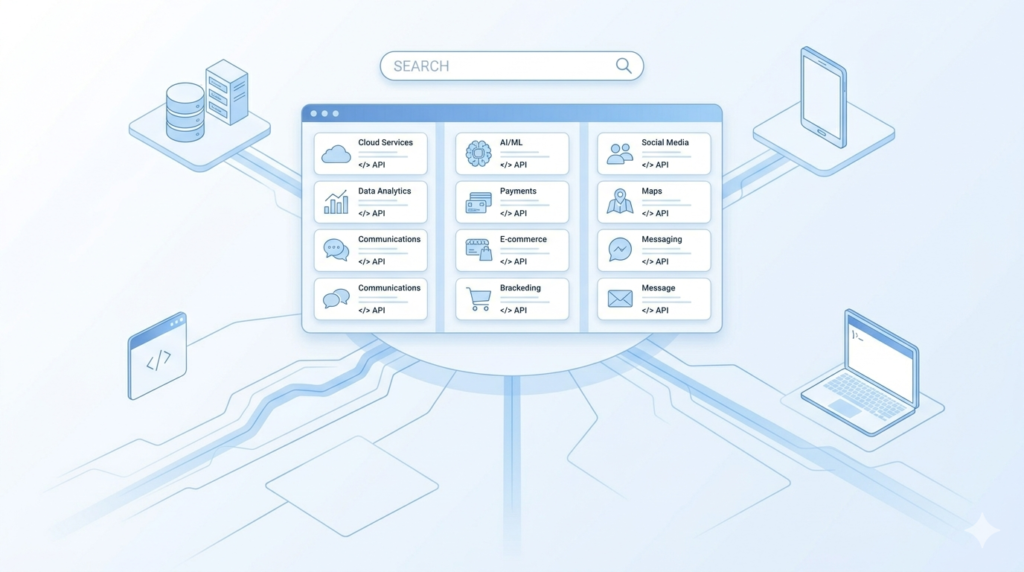
An API search company is a platform or service that helps developers discover, evaluate, and integrate APIs (Application Programming Interfaces) from multiple providers in one place. It acts as a centralized marketplace or directory where APIs can be searched, tested, and compared efficiently.
Technical Definition
An API search company provides a structured API discovery and management system that aggregates APIs, indexes their metadata, and enables programmatic or manual search through endpoints, categories, and use cases. These platforms often include tools for:
- API testing (requests/responses)
- Authentication handling (API keys, OAuth)
- Performance monitoring
- Documentation hosting
Examples include platforms like RapidAPI and Postman, which combine API discovery with testing and integration environments.
Key Characteristics
- Centralized API Directory
Provides access to thousands of APIs across categories like finance, weather, AI, and SEO. - Search & Filtering Capabilities
Advanced filters (category, pricing, latency, popularity) help users quickly find relevant APIs. - Built-in Testing Tools
Allows developers to test endpoints directly without external tools. - Unified Authentication System
Simplifies API access using a single API key or managed credentials. - Analytics & Monitoring
Tracks usage, response times, and error rates.
Summary
API search companies function as API marketplaces and discovery engines, enabling developers to find, test, and integrate APIs quickly without building services from scratch.
Key Takeaways
- API search companies simplify API discovery and integration
- They combine search, testing, and management tools
- Used by developers, startups, and enterprises
- Essential for building modern, scalable applications
How API Search Companies Work
Step-by-Step Process
| Step | Action | Outcome |
|---|---|---|
| 1 | API providers submit their APIs | APIs get listed in the platform database |
| 2 | Platform indexes API metadata | APIs become searchable by keywords, categories, and tags |
| 3 | User searches for an API | Relevant APIs are displayed with filters |
| 4 | User reviews documentation | Understanding of endpoints, parameters, and responses |
| 5 | API testing within platform | Live request/response validation |
| 6 | Authentication setup | API key or OAuth access granted |
| 7 | Integration into application | API is used in real-world projects |
Core Mechanism Explained
API search companies operate using a three-layer system:
- Aggregation Layer
- Collects APIs from different providers
- Standardizes formats and documentation
- Search & Indexing Layer
- Uses advanced search engines (like those powered by Algolia)
- Enables fast, relevant API discovery
- Execution Layer
- Allows real-time API testing
- Handles authentication, rate limits, and responses
Platforms such as RapidAPI integrate all three layers into a unified developer experience.
Example Workflow
A typical developer workflow looks like this:
- Search for “weather API” on a platform like Postman
- Filter results based on pricing and popularity
- Open API documentation and review endpoints
- Test the API directly within the platform
- Copy the code snippet (JavaScript, Python, etc.)
- Integrate it into an application
Summary
API search companies streamline the entire lifecycle—from API discovery to integration—by combining search, documentation, testing, and authentication in one platform.
Key Takeaways
- APIs are aggregated, indexed, and made searchable
- Built-in tools eliminate the need for external testing software
- Developers can go from search → test → integration in minutes
- Platforms reduce development time and complexity
- Types of API Search Companies
API Marketplaces
API marketplaces are platforms that aggregate and distribute APIs from multiple providers in a single ecosystem. They often include pricing models, usage analytics, and unified billing systems.
- Example: RapidAPI
- Key Features:
- Thousands of APIs across categories
- Subscription-based access
- Built-in monetization for API providers
API Discovery & Directory Platforms
These platforms focus on cataloging and organizing APIs for easy discovery, rather than direct monetization or integration.
- Example: ProgrammableWeb
- Key Features:
- API listings and categories
- Detailed descriptions and use cases
- Industry news and updates
API Testing & Collaboration Platforms
These platforms combine API discovery with testing, debugging, and team collaboration tools.
- Example: Postman
- Key Features:
- API request testing
- Automated workflows
- Team collaboration and sharing
Also read:Braves Marcell Ozuna Waiver Candidate: What Really Happened Explained (2026)
Search API Providers
These companies provide search technology APIs that power API discovery systems or can be integrated into applications.
- Example: Algolia
- Key Features:
- Fast indexing and retrieval
- Custom search implementation
- Real-time query handling
Comparison of Types
| Type | Primary Function | Best For | Example |
|---|---|---|---|
| API Marketplace | API distribution & monetization | Developers & startups | RapidAPI |
| API Directory | API discovery & research | Learners & analysts | ProgrammableWeb |
| Testing Platform | API testing & collaboration | Development teams | Postman |
| Search API Provider | Search infrastructure | Developers building search | Algolia |
Summary
API search companies can be grouped into marketplaces, directories, testing platforms, and search providers, each serving a different role in the API ecosystem.
Key points
- Not all API platforms serve the same purpose
- Marketplaces focus on access and monetization
- Directories focus on discovery and learning
- Testing platforms enable development workflows
- Search providers power fast and scalable API search

Benefits of API Search Companies
Key Advantages
- Faster API Discovery
Developers can quickly find relevant APIs using advanced search and filtering instead of manually browsing multiple websites. - Centralized Access
Platforms like RapidAPI provide access to thousands of APIs in one place, reducing fragmentation. - Built-in Testing Environment
Tools from platforms such as Postman allow real-time API testing without external software. - Standardized Documentation
APIs are presented in consistent formats, making it easier to understand endpoints, parameters, and responses. - Unified Authentication & Billing
Many platforms offer a single API key and consolidated billing system, simplifying integration and cost management.
Performance Impact
| Benefit | Impact on Development | Outcome |
|---|---|---|
| Faster Discovery | Reduces research time | Speeds up project start |
| Built-in Testing | Eliminates external tools | Improves efficiency |
| Standardized Docs | Reduces learning curve | Fewer integration errors |
| Centralized Access | One platform for multiple APIs | Better workflow management |
| Analytics & Monitoring | Tracks API performance | Optimized usage |
Business and Technical Benefits
For Developers
- Reduces development time significantly
- Enables rapid prototyping and testing
- Improves code integration efficiency
For Businesses
- Lowers development costs
- Speeds up time-to-market
- Enables scalable application development
For Enterprises
- Provides governance and monitoring tools
- Ensures API reliability and performance tracking
- Supports large-scale system integration
Summary
API search companies improve efficiency by centralizing API discovery, enabling real-time testing, and simplifying integration, resulting in faster development cycles and reduced operational complexity.
Pros and Cons
| Pros | Cons |
|---|---|
| Saves time and effort | Dependency on third-party platforms |
| Simplifies integration | Some APIs may have usage limits |
| Centralized management | Pricing can vary across APIs |
| Built-in testing tools | Platform lock-in risks |
Key Takeaways
- API search companies significantly reduce development time
- They provide all-in-one environments for discovery, testing, and integration
- Businesses benefit from faster deployment and lower costs
- Potential limitations include dependency and pricing variability
Limitations and Challenges
Common Issues
- Dependency on Third-Party Platforms
Relying on platforms like RapidAPI means your application depends on their uptime, policies, and infrastructure. - Inconsistent API Quality
Not all APIs listed are equally reliable or well-maintained, especially in large marketplaces. - Rate Limits and Usage Restrictions
Many APIs enforce request limits, which can affect application performance at scale. - Learning Curve for Complex APIs
Even with standardized documentation, some APIs require advanced technical knowledge. - Versioning and Compatibility Issues
APIs may update or deprecate endpoints, causing integration problems.
Risks or Constraints
| Challenge | Description | Impact |
|---|---|---|
| Platform Lock-In | Heavy reliance on one platform | Reduced flexibility |
| Pricing Variability | Different pricing models across APIs | Budget unpredictability |
| Security Concerns | Handling API keys and sensitive data | Potential vulnerabilities |
| Latency Issues | External API response delays | Slower application performance |
| Limited Customization | Pre-built APIs may not fit exact needs | Reduced control |
Technical Constraints
- Authentication Complexity
Managing API keys, OAuth tokens, and permissions can be challenging, especially across multiple APIs. - Data Reliability
External APIs may return inconsistent or outdated data depending on the provider. - Scalability Limitations
Free or lower-tier plans often restrict scaling capabilities. - Integration Overhead
Combining multiple APIs may increase system complexity and maintenance effort.
Summary
While API search companies simplify development, they introduce challenges such as dependency, rate limits, security risks, and scalability constraints, which must be managed carefully.
Common Mistakes
- Relying on a single API without fallback options
- Ignoring rate limits and quotas
- Not monitoring API performance
- Overlooking security best practices
- Choosing APIs based only on popularity
Key Takeaways
- API platforms come with technical and operational trade-offs
- Dependency and pricing are major considerations
- Security and performance must be actively managed
- Proper planning reduces long-term risks
Use Cases and Real-World Examples
Industry Use Cases
API search companies are widely used across industries to accelerate development and integrate external services efficiently.
- Tools like SerpApi provide structured Google search results
- E-commerce Platforms
- Integrate payment gateways, shipping APIs, and product data
- Example: Using APIs discovered via RapidAPI for currency conversion or logistics
- SEO & Digital Marketing
- Access search data, keyword insights, and SERP analytics
- Finance & FinTech
- Use APIs for real-time stock data, payments, and fraud detection
- Enables secure and scalable financial applications
- Travel & Booking Systems
- Integrate flight, hotel, and location APIs
- Provide real-time availability and pricing
- AI & Machine Learning Applications
- Connect to NLP, vision, and automation APIs
- Platforms like Google Cloud offer AI-powered APIs
Practical Applications
| Use Case | API Function | Outcome |
|---|---|---|
| Weather App | Fetch real-time weather data | Accurate forecasts |
| Chat Application | Integrate messaging APIs | Real-time communication |
| Payment System | Use payment gateway APIs | Secure transactions |
| SEO Tool | Extract search engine results | Data-driven insights |
| Mobile App | Connect third-party services | Faster development |
Also read:
Real-World Workflow Example
A developer building a travel booking app might:
- Search for flight and hotel APIs on Postman
- Compare providers based on pricing and response time
- Test endpoints directly within the platform
- Integrate selected APIs into the backend
- Monitor usage and performance
Summary
API search companies enable real-world applications by connecting systems through ready-to-use APIs, reducing development effort and enabling faster deployment across industries.
Key Takeaways
- APIs power modern applications across industries
- API search platforms simplify finding and integrating these services
- Common use cases include e-commerce, SEO, finance, and AI
- Real-world workflows become faster and more efficient
Tools, Platforms, or Systems Related to API Search Companies
H3: Popular Tools and Platforms
API search companies are supported by a range of tools that enable API discovery, testing, integration, and management.
- RapidAPI
- Large API marketplace with unified billing
- Built-in testing and analytics
- Supports thousands of APIs across categories
- Postman
- API testing, automation, and collaboration
- Postman API Network for discovery
- Widely used in development workflows
- Algolia
- High-performance search infrastructure
- Powers fast API discovery systems
- Real-time indexing and filtering
- APILayer
- Offers curated, ready-to-use APIs
- Focus on reliability and simplicity
- Covers finance, IP, and data APIs
- Zyla API Hub
- Centralized API hub with unified access
- AI-friendly API ecosystem
- Simplified integration process
Feature Comparison
| Platform | Core Function | Key Features | Best For |
|---|---|---|---|
| RapidAPI | API Marketplace | Unified billing, analytics | API access & monetization |
| Postman | Testing & Collaboration | API testing, automation | Development teams |
| Algolia | Search API | Fast indexing, search engine | Building search systems |
| APILayer | API Provider | Reliable APIs, easy integration | Quick implementation |
| Zyla API Hub | API Marketplace | Unified API access | AI & automation use cases |
Supporting Systems and Technologies
API search companies rely on underlying systems to function efficiently:
- API Gateways
- Manage API requests, authentication, and rate limiting
- Ensure secure communication between client and server
- Search Engines & Indexing Systems
- Enable fast and relevant API discovery
- Often powered by technologies similar to Algolia
- Authentication Systems
- Handle API keys, OAuth tokens, and access control
- Ensure secure API usage
- Monitoring & Analytics Tools
- Track API performance, usage, and errors
- Help optimize integration and reliability
Summary
API search companies are supported by powerful tools and systems that handle discovery, testing, security, and performance—creating a complete ecosystem for API integration.
Key Takeaways
- Multiple tools work together to power API search platforms
- Marketplaces, testing tools, and search engines serve different roles
- Supporting systems ensure security, speed, and scalability
- Choosing the right platform depends on use case and requirements
Best Practices
Optimization Tips
- Use Advanced Search Filters
Apply filters like category, latency, pricing, and popularity to quickly find the most suitable APIs on platforms such as RapidAPI. - Evaluate API Documentation Carefully
Review endpoints, request parameters, and response formats to ensure compatibility with your application. - Test APIs Before Integration
Use built-in tools from Postman to validate responses, error handling, and performance. - Check Rate Limits and Quotas
Always verify usage limits to avoid unexpected service disruptions. - Monitor Performance Metrics
Track response times, uptime, and error rates to ensure reliability.
Expert Recommendations
- Choose APIs Based on Use Case, Not Popularity
The most popular API may not always be the best fit for your specific requirements. - Implement Fallback Mechanisms
Use backup APIs to maintain service continuity in case of failures. - Secure API Credentials
Protect API keys and tokens using environment variables and secure storage practices. - Optimize for Scalability
Select APIs that can handle increased traffic and offer scalable pricing plans. - Regularly Update Integrations
Keep track of API version changes and updates to avoid compatibility issues.
Best Practices Checklist
| Practice | Purpose | Outcome |
|---|---|---|
| Test APIs | Validate functionality | Fewer errors |
| Monitor usage | Track performance | Better reliability |
| Secure credentials | Prevent breaches | Improved security |
| Use fallback APIs | Avoid downtime | High availability |
| Review documentation | Ensure compatibility | Smooth integration |
Summary
Following best practices ensures efficient, secure, and scalable API integration, reducing risks and improving long-term performance.
Common Mistakes to Avoid
- Ignoring API rate limits
- Skipping testing before deployment
- Using unsecured API keys
- Not monitoring API performance
- Over-relying on a single provider
Key Takeaways
- Proper API selection and testing are critical
- Security and monitoring should never be ignored
- Scalability and fallback planning improve reliability
- Best practices reduce long-term technical issues
Common Mistakes to Avoid
Beginner Mistakes
- Ignoring API Documentation
Many developers skip reading full documentation and miss key details like authentication methods, rate limits, or required parameters. - Not Testing APIs Properly
Failing to test APIs using tools like Postman can lead to unexpected errors in production environments. - Choosing APIs Based Only on Popularity
Selecting an API just because it is widely used (e.g., from RapidAPI listings) without evaluating suitability can lead to poor integration results. - Hardcoding API Keys
Storing API keys directly in source code creates serious security vulnerabilities. - Ignoring Rate Limits
Not accounting for request quotas can cause service disruptions or API bans.
Misconceptions
- “All APIs are plug-and-play”
In reality, most APIs require configuration, authentication, and careful integration. - “Free APIs are always enough”
Free tiers often have limitations in speed, reliability, or data access. - “One API can solve everything”
Complex applications usually require multiple APIs working together. - “Once integrated, APIs don’t change”
APIs evolve, and updates or deprecations can break existing systems.
Common Mistakes Table
| Mistake | Why It Happens | Impact |
|---|---|---|
| Skipping documentation | Assumption of simplicity | Integration errors |
| No testing | Rushing development | Production failures |
| Hardcoding keys | Poor security practices | Data breaches |
| Ignoring limits | Lack of planning | Service downtime |
| Over-reliance on one API | Convenience bias | System fragility |
Summary
Most API integration problems come from poor planning, lack of testing, and ignoring technical constraints, not from the APIs themselves.
Key Risks Highlighted
- Security vulnerabilities from exposed credentials
- System failures due to rate limit violations
- Maintenance issues from outdated integrations
- Performance degradation under heavy usage
Key Takeaways
- Proper API usage requires careful planning and testing
- Security and rate limits are critical factors
- APIs evolve, so updates must be monitored
- Avoid relying on assumptions about simplicity or stability
Key Takeaways
Core Understanding
- API search companies are platforms that help developers discover, test, and integrate APIs efficiently from a centralized ecosystem.
- They reduce the complexity of working with multiple API providers by offering search, documentation, and testing tools in one place.
- Platforms like RapidAPI and Postman are leading examples of this ecosystem.
Strategic Value
- Faster Development Cycles
Developers can go from idea → API discovery → integration in minutes instead of days. - Improved Productivity
Built-in testing and standardized documentation reduce manual effort. - Better Scalability
Businesses can easily add or replace APIs as needs evolve. - Lower Development Costs
Reusing APIs eliminates the need to build complex systems from scratch.
Ecosystem Importance
API search companies play a key role in the modern digital ecosystem by:
- Connecting API providers with developers
- Enabling software interoperability
- Supporting AI, SaaS, and cloud-based innovation
- Powering modern applications across industries
Final Insight
The API economy continues to grow rapidly, and API search platforms are becoming the central infrastructure layer of modern software development, enabling faster innovation, easier integration, and scalable digital products.
Final Summary
API search companies are essential tools in modern development, acting as centralized hubs for API discovery, testing, and integration, significantly accelerating how software is built and scaled.
Final Takeaways
- API search platforms simplify complex integrations
- They are critical to modern software and AI ecosystems
- They improve speed, scalability, and efficiency
- Their importance will continue to grow with AI and cloud adoption