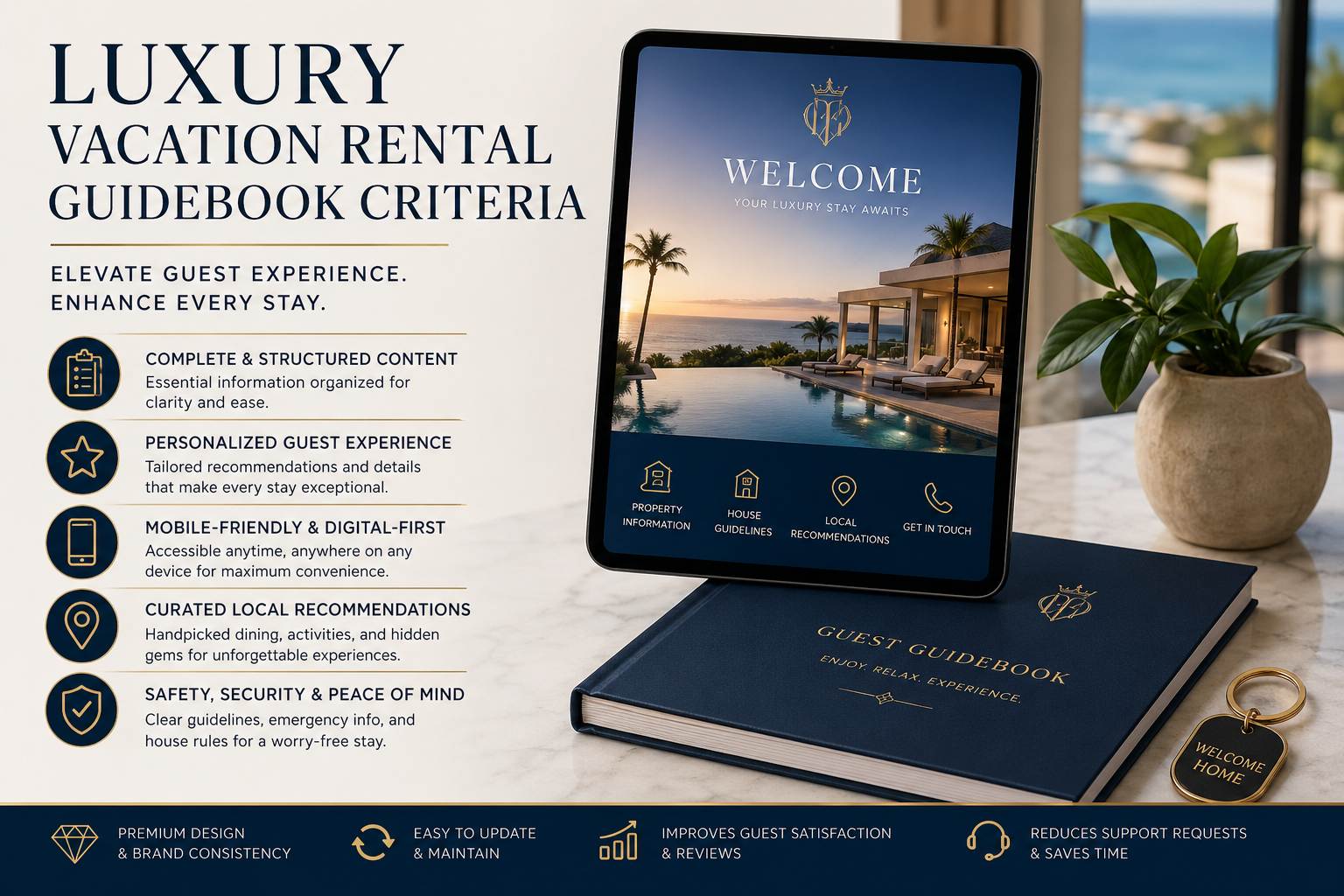
A luxury vacation rental guidebook is a premium, structured guest resource designed to deliver a seamless, high-end experience throughout the stay. It combines essential property information with personalized recommendations, concierge-level guidance, and brand-aligned communication to meet elevated guest expectations.
Definition and Purpose
A luxury guidebook functions as a centralized experience manual that helps guests:
- Navigate the property effortlessly
- Access amenities and services without friction
- Discover curated local experiences
- Understand house expectations in a refined, non-restrictive tone
Unlike basic guidebooks, it emphasizes clarity, personalization, and experiential value rather than just instructions.
Standard vs Luxury Guidebook
| Criteria | Standard Guidebook | Luxury Guidebook |
|---|---|---|
| Content Depth | Basic instructions | Comprehensive + experiential |
| Tone | Functional | Refined, brand-aligned |
| Personalization | Minimal | Highly personalized |
| Design | Simple text | Premium visual layout |
| Recommendations | Generic | Curated, high-end |
| Format | Often static | Digital, interactive, multi-format |
Role in the Guest Journey
A luxury guidebook supports every stage of the guest lifecycle:
| Stage | Role of Guidebook |
|---|---|
| Pre-arrival | Sets expectations, builds anticipation |
| Arrival | Simplifies check-in and orientation |
| During stay | Enhances comfort and discovery |
| Post-stay | Reinforces brand memory and satisfaction |
Key Characteristics of a Luxury Guidebook
- Structured and easy to navigate
- Visually polished and brand-consistent
- Mobile-friendly and accessible
- Integrated with guest needs and behavior
- Focused on experience, not just information
Summary
A luxury vacation rental guidebook is not just an instruction manual—it is a guest experience tool that blends hospitality standards, personalization, and curated content to elevate the overall stay.
Keypoints
- Defines the standard of service before human interaction
- Reduces guest confusion and support requests
- Enhances perceived property value
- Acts as a digital concierge for high-end travelers
- Directly impacts guest satisfaction and reviews
Core Criteria of a Luxury Guidebook
A luxury vacation rental guidebook is defined by structured quality standards that prioritize usability, personalization, and premium guest experience. These criteria ensure the guidebook functions as a high-end hospitality tool, not just an informational document.
Clarity and Usability Standards
Luxury guests expect instant understanding without effort. Information must be:
- Clearly structured with logical sections
- Easy to scan (headings, bullets, short paragraphs)
- Free from ambiguity or unnecessary detail
Key elements:
- Step-by-step instructions for all processes
- Clearly labeled sections (Wi-Fi, check-in, amenities)
- Consistent formatting across pages
Personalization and Guest Targeting
Personalization transforms a generic guidebook into a tailored guest experience.
Key requirements:
- Customized welcome message
- Recommendations based on guest type (family, couple, business traveler)
- Location-specific insights
- Context-aware suggestions (seasonal, events, local trends)
Visual and Brand Consistency
Luxury positioning requires strong visual identity and cohesive branding.
Standards include:
- Consistent color palette and typography
- High-quality images of property and surroundings
- Branded tone of voice across all sections
- Alignment with property’s luxury positioning
Accessibility and Multi-Format Availability
A luxury guidebook must be accessible anytime, on any device.
Formats:
- Mobile-optimized digital version
- Printable PDF version
- Optional in-property printed copy
Accessibility features:
- Fast loading and easy navigation
- Clear fonts and readable layouts
- Multilingual support where applicable
Information Depth and Relevance
Content must be comprehensive but not overwhelming.
Best practices:
- Include only high-value, relevant information
- Prioritize frequently used details
- Avoid redundant or low-impact content
Guest Experience Optimization
The guidebook should actively reduce friction and enhance comfort.
This includes:
- Anticipating guest questions
- Providing proactive solutions
- Offering curated experiences rather than generic listings
Summary
Core criteria of a luxury guidebook revolve around clarity, personalization, branding, accessibility, and experience optimization, ensuring every interaction feels seamless and premium.
Keypoints
- Clear structure improves usability and reduces confusion
- Personalization increases guest satisfaction
- Strong branding reinforces luxury perception
- Multi-format access ensures convenience
- Experience-focused content differentiates from standard rentals
Pros and Cons of High-End Guidebook Standards
Pros
- Higher guest satisfaction and reviews
- Reduced support inquiries
- Strong brand perception
- Increased repeat bookings
Cons
- Requires time and strategic planning
- Needs regular updates
- Higher design and content effort
Common Mistakes
- Overloading with unnecessary details
- Using generic, non-personalized content
- Poor formatting and readability
- Ignoring mobile optimization
- Lack of brand consistency
Read also:https://capitallooms.com/denture-reline/
Essential Sections Every Luxury Guidebook Must Include
A luxury vacation rental guidebook must follow a structured, complete content framework that supports the entire guest journey. Each section should be designed to reduce friction, deliver clarity, and enhance the overall experience.
Welcome Message and Brand Introduction
A high-end guidebook begins with a personalized, brand-aligned welcome.
Key elements:
- Warm, concise greeting
- Property positioning (luxury, boutique, family-friendly, etc.)
- Brief overview of what guests can expect
Purpose:
- Establish tone and trust
- Create an immediate premium impression
Property Overview and Amenities
This section provides a clear understanding of the space and available features.
Include:
- Room breakdown and layout
- Key amenities (pool, gym, smart systems, kitchen features)
- Unique selling points of the property
Best practice:
- Use structured lists instead of long paragraphs
Check-In and Check-Out Instructions
Guests expect frictionless arrival and departure.
Include:
- Step-by-step check-in process
- Access methods (lockbox, smart lock, concierge)
- Check-out procedures
- Timing and expectations
Optimization:
- Keep instructions simple and sequential
House Rules (Luxury Tone)
Luxury properties require refined, non-restrictive communication.
Include:
- Essential rules only
- Polite, professional tone
- Clear expectations without sounding strict
Example approach:
- “We kindly ask…” instead of “Do not…”
Wi-Fi, Utilities, and Technology Instructions
This is one of the most frequently accessed sections.
Include:
- Wi-Fi name and password
- Instructions for TV, streaming, smart devices
- Appliance usage (AC, heating, kitchen equipment)
Goal:
- Eliminate confusion and support requests
Safety, Emergency, and Compliance Information
A luxury guidebook must include clear and accessible safety details.
Include:
- Emergency contacts
- Nearest hospital or clinic
- Fire safety instructions
- Security systems (if applicable)
Requirement:
- Information must be easy to find and clearly labeled
Concierge Recommendations and Local Experiences
Luxury guests expect curated, high-quality recommendations.
Include:
- Restaurants (fine dining, local favorites)
- Experiences (tours, spas, activities)
- Shopping and entertainment
- Hidden gems
Best practice:
- Avoid generic lists—focus on curated, premium options
Transportation and Local Navigation
Provide practical mobility guidance.
Include:
- Airport transfer options
- Public transport details
- Car rental or chauffeur services
- Parking instructions
Purpose:
- Simplify movement and planning
Frequently Asked Questions (FAQs)
FAQs reduce repetitive guest inquiries.
Include:
- Early check-in availability
- Late check-out policies
- Lost keys or access issues
- Maintenance or support contact
Structure:
- Direct question-and-answer format
Summary
Essential sections in a luxury guidebook ensure complete guest support from arrival to departure, combining operational clarity with curated experiences.
Keypoints
- A structured guidebook reduces guest confusion
- Each section should serve a clear purpose
- Concierge recommendations define luxury positioning
- FAQs improve efficiency and reduce support workload
- Clear instructions enhance overall satisfaction
Table: Required Sections and Their Purpose
| Section | Purpose |
|---|---|
| Welcome Message | Establish tone and brand identity |
| Property Overview | Explain layout and features |
| Check-In/Out | Ensure smooth arrival and departure |
| House Rules | Set expectations professionally |
| Wi-Fi & Tech | Enable easy access to essentials |
| Safety Info | Provide security and compliance |
| Concierge | Enhance guest experience |
| Transportation | Simplify navigation |
| FAQs | Reduce common inquiries |
Common Mistakes
- Missing essential sections
- Providing vague or unclear instructions
- Using generic recommendations
- Overcomplicating simple processes
- Poor organization of information
Luxury-Level Enhancements That Elevate Guest Experience
Luxury guidebooks go beyond essential information by integrating experience-driven enhancements that differentiate high-end rentals from standard accommodations. These elements are designed to anticipate guest needs, increase perceived value, and deliver a concierge-level experience.
Personalized Recommendations
Personalization is a defining feature of luxury hospitality.
Include:
- Tailored suggestions based on guest type (couples, families, business travelers)
- Occasion-based recommendations (honeymoon, vacation, work stay)
- Seasonal and event-based activities
Impact:
- Increases engagement and satisfaction
- Creates a sense of exclusivity
VIP Services and Concierge Add-Ons
Luxury guests expect access to premium, on-demand services.
Examples:
- Private chef or catering services
- Spa and wellness bookings
- Chauffeur or private transport
- Event or experience reservations
Best practice:
- Present services clearly with contact or booking instructions
Smart Home and Technology Integration
Modern luxury properties often include advanced technology systems.
Include:
- Smart lock instructions
- Lighting and climate control systems
- Entertainment systems and streaming setup
- Voice assistants or automation features
Goal:
- Ensure guests can use all technology without confusion
Experience-Based Content and Storytelling
Luxury guidebooks should create a sense of place and emotional connection.
Include:
- Brief narratives about the property or location
- Unique features or design inspiration
- Highlighted “signature experiences”
Purpose:
- Elevate the stay from functional to memorable
Multilingual and Cultural Adaptation
High-end properties often serve international guests.
Include:
- Multiple language options
- Cultural considerations in communication
- Region-specific guidance (customs, etiquette, tipping norms)
Benefit:
- Improves accessibility and comfort for global travelers
Proactive Guest Support Information
Luxury guidebooks anticipate needs before they arise.
Include:
- Troubleshooting tips (Wi-Fi, appliances, access issues)
- Clear support contact channels
- Response time expectations
Outcome:
- Reduces friction and support requests
Summary
Luxury-level enhancements transform a guidebook into a personalized, concierge-style experience tool, delivering value through customization, technology, and curated services.
Keypoints
- Personalization is essential for luxury positioning
- Concierge services increase perceived value
- Smart technology must be easy to use
- Experience-driven content creates emotional impact
- Multilingual support expands accessibility
Pros and Cons of Luxury Enhancements
Pros
- Higher guest satisfaction and retention
- Strong differentiation from competitors
- Increased upsell opportunities
- Enhanced brand perception
Cons
- Requires continuous updates
- Higher operational complexity
- May require integration with service providers
Common Mistakes
- Offering generic, non-curated recommendations
- Including technology without clear instructions
- Ignoring international guest needs
- Overcomplicating service access
- Lack of clarity in booking or contact details
Design and Formatting Standards
Design and formatting define how effectively a luxury guidebook delivers information. High-end guests expect clean, visually refined, and highly readable layouts that make navigation effortless while reinforcing the property’s premium positioning.
Visual Hierarchy and Readability
A luxury guidebook must be easy to scan and navigate.
Best practices:
- Use clear heading structures and consistent spacing
- Break content into short sections and bullet points
- Highlight key information (Wi-Fi, check-in steps, contacts)
- Avoid dense text blocks
Outcome:
- Faster information access
- Reduced cognitive load for guests
Typography and Layout
Typography directly impacts perceived quality and usability.
Standards:
- Use elegant, readable fonts
- Maintain consistent font sizes for headings and body text
- Apply proper spacing between sections
- Align text and visuals cleanly
Goal:
- Create a polished, professional appearance
Image Quality and Visual Content
Luxury guidebooks require high-quality visual assets.
Include:
- Professional property images
- Clear icons for sections (Wi-Fi, rules, safety)
- Visual cues for navigation
Guidelines:
- Avoid low-resolution or cluttered images
- Ensure images support content, not distract from it
Mobile-First Formatting
Most guests access guidebooks on mobile devices.
Requirements:
- Responsive design for all screen sizes
- Fast loading speed
- Easy scrolling and navigation
- Clickable sections and links
Impact:
- Improves accessibility and user experience
Structured Content Layout
Information must follow a logical and predictable flow.
Structure:
- Introduction → Instructions → Recommendations → Support
- Group related topics together
- Maintain consistency across all sections
Benefit:
- Helps guests find information quickly without confusion
Format Types: PDF, Web, and App-Based
Different formats serve different use cases.
| Format | Advantages | Limitations |
|---|---|---|
| Easy to share, printable | Limited interactivity | |
| Web-based | Interactive, updatable | Requires internet access |
| App-based | Advanced features, integration | Higher setup effort |
Best practice:
- Use a hybrid approach for maximum accessibility
Branding Integration
Design must reflect the property’s luxury identity.
Include:
- Consistent color scheme
- Logo placement
- Brand tone in text and visuals
Purpose:
- Reinforce brand recognition and trust
Summary
Design and formatting standards ensure that a luxury guidebook is visually appealing, easy to use, and aligned with premium brand expectations, directly influencing guest perception and satisfaction.
Keypoints
- Clear hierarchy improves usability
- Typography affects readability and perception
- High-quality visuals reinforce luxury positioning
- Mobile-first design is essential
- Structured layouts reduce friction
Pros and Cons of Advanced Design Standards
Pros
- Enhances guest experience
- Strengthens brand identity
- Improves usability and engagement
- Supports premium positioning
Cons
- Requires design expertise
- Higher production effort
- Needs regular updates for consistency
Common Mistakes
- Overdesigning with too many visuals
- Poor font choices affecting readability
- Ignoring mobile optimization
- Inconsistent layout across sections
- Using low-quality images
Digital vs Printed Guidebooks
Luxury vacation rentals increasingly use digital guidebooks, but printed versions still play a role. The choice depends on guest preferences, property positioning, and operational strategy. High-end properties often adopt a hybrid model to maximize accessibility and experience.
Digital Guidebooks
Digital formats include web-based, app-based, or interactive PDFs.
Advantages:
- Instantly accessible on mobile devices
- Easy to update in real time
- Interactive elements (links, maps, videos)
- Supports personalization and automation
Limitations:
- Requires internet or device access
- May be overlooked if not shared properly
Best use:
- Primary guidebook for modern, tech-enabled guest journeys
Printed Guidebooks
Printed versions provide a tangible, in-property reference.
Advantages:
- Always accessible without devices
- Enhances perceived luxury when well-designed
- Useful for quick reference
Limitations:
- Difficult to update
- Limited interactivity
- Higher printing and maintenance cost
Best use:
- Complementary resource placed inside the property
Hybrid Model Strategy
Luxury properties benefit most from a combined approach.
Structure:
- Digital guidebook as the primary source
- Printed version for quick, offline access
Implementation:
- Provide QR code linking to digital guidebook
- Keep printed version concise and essential-focused
Outcome:
- Ensures convenience for all guest preferences
Use Case Comparison
| Scenario | Recommended Format |
|---|---|
| Tech-savvy guests | Digital |
| International travelers | Hybrid |
| Short stays | Digital |
| Family or older guests | Printed + Digital |
| High-end branded stays | Hybrid |
Guest Experience Impact
Format choice directly affects usability:
- Digital improves speed and interactivity
- Printed improves comfort and accessibility
- Hybrid ensures maximum satisfaction and flexibility
Summary
Digital guidebooks provide flexibility, scalability, and interactivity, while printed versions offer convenience and tactile value. A hybrid model delivers the best overall luxury experience.
Keypoints
- Digital is essential for modern guest expectations
- Printed adds a premium physical touch
- Hybrid approach maximizes accessibility
- Format choice should match guest demographics
- Easy access is critical for usability
Pros and Cons Comparison
Digital Guidebook
Pros:
- Easy updates
- Interactive
- Mobile-friendly
Cons:
- Device dependent
- Requires proper distribution
Printed Guidebook
Pros:
- Always accessible
- Enhances physical experience
Cons:
- Hard to update
- Limited functionality
Common Mistakes
- Relying only on printed materials
- Not optimizing digital for mobile
- Providing outdated printed information
- No clear access to digital version
- Overloading printed guidebooks with too much detail
Tools and Platforms to Create Luxury Guidebooks
Creating a luxury vacation rental guidebook requires specialized tools and platforms that support design quality, automation, and seamless guest access. The right platform ensures the guidebook is professional, scalable, and easy to manage.
Guidebook Creation Platforms
Dedicated guidebook platforms are designed specifically for short-term rentals.
Common features:
- Pre-built templates for rentals
- Mobile-optimized layouts
- Interactive elements (maps, links, recommendations)
- Easy content updates
Examples of platforms:
- Hostfully
- Touch Stay
Use case:
- Best for property managers and hosts seeking all-in-one solutions
Design and Content Tools
These tools focus on visual design and customization.
Capabilities:
- Custom layouts and branding
- Image editing and visual enhancement
- Flexible formatting
Examples:
- Canva
- Notion
Use case:
- Ideal for creating highly branded, visually polished guidebooks
Automation and Integration Tools
Automation tools help streamline guest communication and content delivery.
Functions:
- Auto-send guidebooks after booking
- Integrate with booking platforms
- Update content dynamically
Common integrations:
- Property management systems (PMS)
- Booking platforms
- Messaging automation tools
Benefit:
- Reduces manual work and ensures consistency
Platform Comparison Table
| Platform Type | Strength | Limitation | Best For |
|---|---|---|---|
| Dedicated Guidebook Tools | Ease of use, rental-specific features | Limited deep customization | Hosts & property managers |
| Design Tools | High customization, branding control | Manual setup required | Premium branded properties |
| Automation Tools | Efficiency and scalability | Requires integration setup | Multi-property operations |
Selection Criteria
When choosing a platform, evaluate:
- Ease of use and setup
- Mobile optimization
- Customization and branding options
- Integration capabilities
- Scalability for multiple properties
Summary
The best tools for luxury guidebooks combine ease of use, strong design capabilities, and automation, enabling hosts to deliver a seamless and premium guest experience.
Keypoints
- Dedicated platforms simplify guidebook creation
- Design tools enhance branding and visual quality
- Automation tools improve efficiency
- Integration with booking systems is essential
- Platform choice depends on scale and customization needs
Pros and Cons of Using Tools
Pros
- Faster guidebook creation
- Professional design output
- Easy updates and scalability
- Improved guest communication
Cons
- Subscription costs
- Learning curve for advanced features
- Dependency on platform ecosystem
Common Mistakes
- Choosing tools without mobile optimization
- Ignoring integration with booking systems
- Overcomplicating design with too many tools
- Not updating content regularly
- Using generic templates without customization
SEO + GEO Optimization for Guidebooks
Luxury vacation rental guidebooks can be optimized to support search visibility, AI extraction, and local discovery. Proper SEO (Search Engine Optimization) and GEO (Generative Engine Optimization) ensure the guidebook content is structured, discoverable, and usable by both users and AI systems.
Local Keyword Integration
Guidebooks should include location-specific keywords naturally within content.
Best practices:
- Mention city, neighborhood, and landmarks
- Include phrases guests search for (e.g., “best restaurants near [location]”)
- Align recommendations with local search intent
Benefit:
- Improves relevance for local search and voice queries
Structured and Scannable Content
Search engines and AI systems prefer well-structured information.
Optimization techniques:
- Use clear headings and subheadings
- Break content into lists and sections
- Provide direct answers to common questions
Outcome:
- Higher chances of appearing in featured snippets and AI summaries
AI-Extractable Answer Blocks
Content should be written in a way that AI systems can easily extract and summarize.
Include:
- Short, factual definitions
- Bullet-point answers
- Direct responses to questions
Example structure:
- Question → concise answer → supporting details
Voice Search Optimization
Many users access information via voice assistants.
Strategies:
- Use natural, conversational phrasing
- Answer “who, what, where, how” queries clearly
- Include concise, direct responses
Impact:
- Increases visibility in voice-based searches
Internal Linking and Navigation
Guidebooks should include logical internal connections.
Examples:
- Link sections (e.g., amenities → usage instructions)
- Provide quick navigation to key areas
- Use clickable elements in digital formats
Benefit:
- Enhances usability and engagement
Content Freshness and Updates
Search systems prioritize updated and relevant information.
Requirements:
- Regularly update recommendations
- Refresh seasonal content
- Ensure accuracy of contact details and services
Result:
- Maintains credibility and ranking potential
GEO-Specific Signals
Generative Engine Optimization focuses on AI comprehension and context completeness.
Key signals:
- Explicit definitions of concepts
- Complete contextual explanations
- Consistent terminology
- Fact-based, neutral statements
Goal:
- Make content easily usable by AI engines like ChatGPT, Gemini, and others
Summary
SEO and GEO optimization ensure that a luxury guidebook is not only useful for guests but also structured for search engines and AI systems, increasing visibility, usability, and long-term value.
Keypoints
- Local keywords improve geographic relevance
- Structured content enhances AI extraction
- Direct answers support featured snippets
- Voice optimization increases accessibility
- Regular updates maintain accuracy and rankings
Pros and Cons of SEO + GEO Optimization
Pros
- Higher discoverability
- Better AI visibility
- Improved user experience
- Increased engagement
Cons
- Requires ongoing updates
- Needs strategic content planning
- May require technical implementation
Common Mistakes
- Ignoring local keyword usage
- Writing unstructured, long paragraphs
- Not optimizing for AI-readable formats
- Outdated or inaccurate information
- Lack of internal navigation
Common Mistakes in Luxury Guidebooks
Even well-designed luxury vacation rental guidebooks can fail if they ignore usability, clarity, and guest experience principles. These mistakes reduce perceived value, increase guest confusion, and negatively impact reviews.
Overloading Information
One of the most common issues is including too much unnecessary detail.
Problems:
- Long, dense paragraphs
- Irrelevant property or local information
- Repetitive instructions
Impact:
- Guests struggle to find key information quickly
- Reduced usability and engagement
Best practice:
- Prioritize only high-value, frequently needed content
Lack of Personalization
Luxury guests expect a tailored experience, not generic content.
Mistakes:
- One-size-fits-all recommendations
- No guest-type segmentation
- Generic welcome messages
Impact:
- Weak emotional connection to the property
- Lower perceived luxury value
Poor Structure and Navigation
Disorganized guidebooks create friction in the guest experience.
Mistakes:
- Missing headings or inconsistent structure
- No logical flow between sections
- Hard-to-find essential information
Impact:
- Increased guest frustration
- Higher support requests
Weak Branding and Design Consistency
Luxury positioning depends heavily on visual identity.
Mistakes:
- Inconsistent fonts and colors
- Low-quality images
- Generic templates without customization
Impact:
- Reduced premium perception
- Lack of brand recognition
Outdated or Incorrect Information
Guidebooks lose credibility when they are not maintained.
Mistakes:
- Incorrect Wi-Fi passwords
- Outdated restaurant recommendations
- Missing updated contact details
Impact:
- Guest dissatisfaction
- Increased complaints and confusion
Poor Mobile Optimization
Most guests use mobile devices, so poor mobile design is a major issue.
Mistakes:
- Hard-to-read text on small screens
- Slow loading digital guidebooks
- Non-clickable links or navigation issues
Impact:
- Reduced accessibility
- Poor user experience
Missing Key Information
Some guidebooks fail by omitting essential details.
Common missing elements:
- Emergency contacts
- Check-in/out instructions
- Appliance usage guidance
- Local transportation info
Impact:
- Increased guest dependency on host support
Summary
Common mistakes in luxury guidebooks usually stem from poor structure, lack of personalization, outdated content, and weak design execution, all of which reduce guest satisfaction and brand value.
Keypoints
- Too much information reduces usability
- Personalization is essential for luxury positioning
- Structure directly affects guest experience
- Branding consistency builds trust
- Updates are critical for accuracy
Pros and Cons of Avoiding These Mistakes
Pros
- Higher guest satisfaction
- Fewer support requests
- Stronger luxury perception
- Better reviews and retention
Cons (if ignored)
- Negative guest experience
- Lower ratings
- Reduced booking conversions
- Damage to brand reputation
Common Fixes
- Simplify and prioritize content
- Add personalization layers
- Maintain structured navigation
- Regularly update all details
- Optimize for mobile-first usage

Afreen Abid khan
Free
Upgrade
ChatGPTGet Plus
Share
You said:
Advanced SEO + AIO + GEO Content Writing Prompt (Section-by-Section Control) You are an expert SEO content writer, semantic SEO specialist, AI Overview Optimization (AIO) strategist, Generative Engine Optimization (GEO) expert, and Google E-E-A-T authority strategist. I want you to create a fully optimized, informational, fact-driven article for my website that is designed to rank in: ● Google organic search ● Google AI Overviews ● Featured Snippets ● People Also Ask (PAA) ● AI answer engines (ChatGPT, Gemini, Perplexity, Claude, etc.) Follow the instructions very strictly. WORKFLOW RULE (MANDATORY) 1. First, you must ONLY generate the complete outline and content blueprint. 2. Do NOT write the full article at once. 3. Do NOT write any section content unless I explicitly command it. 4. After the outline is approved, you will: ○ Write one section at a time ○ Only when I say: � � “Write H2: [section name]” or � � “Write next section” 5. Never write multiple sections together unless explicitly instructed. BEFORE WRITING ANY CONTENT Generate a complete and detailed content blueprint only. The outline must include: 1. Search Intent Analysis ○ Primary intent ○ Secondary intents ○ AI/LLM interpretation of the query 2. Topical & Semantic Coverage Plan ○ Core topic ○ Supporting subtopics ○ Related concepts Google expects ○ Content gap analysis (what competitors usually miss) 3. Full Heading Structure ○ H1 (primary intent) ○ H2s (topical clusters) ○ H3s and H4s (semantic expansion) 4. Entities & Knowledge Graph Terms ○ People ○ Organizations ○ Tools ○ Standards ○ Metrics ○ Locations (if applicable) 5. Tables to Be Included ○ Comparison tables ○ Definition tables ○ Step-by-step tables ○ Statistics or data tables 6. Featured Snippet Strategy ○ Paragraph snippet (45–55 words) ○ List snippet ○ Table snippet ○ Definition snippet 7. People Also Ask (PAA) Topics ○ Exact questions ○ Search intent behind each question 8. AI Overview Optimization (AIO) Plan ○ Bullet-point answers suitable for Google AI Overviews ○ Clear, extractable facts ○ Short, authoritative explanations ○ Neutral, citation-friendly phrasing 9. Generative Engine Optimization (GEO) Signals ○ Direct question-answer formatting ○ Context completeness for LLMs ○ Explicit definitions ○ Source-ready factual statements 10. Internal Content Blocks ○ Summary boxes ○ Key takeaways ○ Pros / Cons (where applicable) ○ Common mistakes or misconceptions ❗ Important Rule Do NOT write any article content until I say: � � “Write H2: [section name]” or � � “Start writing section by section.” WHEN WRITING A SECTION (ON MY COMMAND) 1. Formatting & Structure ● Follow correct H-tag hierarchy ● Write only the requested section ● No filler — every sentence must add value ● Short, factual paragraphs ● Use tables, bullets, and steps where relevant ● Add mini: ○ Summary box ○ Takeaways ○ Pros/cons (if applicable) 2. SEO + AIO + GEO Requirements ● Deep semantic coverage of the section topic ● Natural keyword variations ● Entity inclusion ● AI Overview-ready bullet answers ● PAA alignment ● Featured snippet compatibility 3. E-E-A-T Guidelines ● Expert-level explanations ● Data-backed statements ● Industry standards and best practices ● Neutral, authoritative tone 4. Citation-Friendly Writing ● Clear, quotable facts ● Concise definitions ● Light citation language: ○ (According to industry standards…) ○ (Based on observed search behavior…) ○ (As documented by leading platforms…) 5. Writing Style ● Informational only ● No opinions ● No storytelling unless necessary ● Human-readable + AI-extractable, ● Clean, professional, educational AFTER ALL SECTIONS ARE COMPLETED Include (only when instructed): 1. Short conclusion 2. FAQs (5–7) 3. Complete references list (credible sources only) make sure not use this ,dont use ,Do not use heading labels like H1, H2, H3 in the content. Use a “Summary” heading instead of a summary box. Use “Keypoints” instead of “Key Takeaways”. Use proper, relevant headings for every paragraph with clear hierarchy. Cover all related topics connected to the main keyword. Keep the content concise, clear, and to the point. Avoid unnecessary long explanations to maintain good user experience. Use only one main heading in the content section (as the first heading). All other headings should be structured as subheadings and nested properly. Include all important and relevant information for each section. Before starting the content, explain: Keyword type (e.g., informational, commercial, navigational) Category (e.g., tool, app, software, media, sports, etc.) Main search intent behind the keyword Ensure the content is fully optimized for high-competition SEO (GEO + AI overview friendly).Show more
ChatGPT said:
You haven’t provided the target keyword/topic for the article yet—and everything in this workflow depends on that.
Before I generate the full SEO + AIO + GEO content blueprint, I need:
Please provide:
- Primary keyword / topic
- (Optional but helpful)
- Target country/location
- Audience (e.g., beginners, professionals, local customers)
- Business type or niche
- Any competitors you want to outrank
Once you share the keyword, I’ll generate a complete, high-level content blueprint including:
- Search intent breakdown
- Semantic coverage
- Full heading structure
- Entities & knowledge graph terms
- Snippet strategy
- PAA questions
- AIO + GEO optimization plan
I’ll strictly follow your workflow and won’t write the article yet until you approve the outline.
You said:
luxury vacation rental guidebook criteria
ChatGPT said:
Here is your complete SEO + AIO + GEO content blueprint for the keyword:
Content Blueprint: Luxury Vacation Rental Guidebook Criteria
Keyword Classification (Pre-Content Requirement)
- Keyword Type: Informational (with commercial investigation intent)
- Category: Hospitality / Travel / Property Management
- Main Search Intent:
Users want to understand what should be included in a luxury vacation rental guidebook, including standards, structure, and best practices to enhance guest experience and meet premium expectations.
1. Search Intent Analysis
Primary Intent
- Learn the criteria, structure, and components of a luxury vacation rental guidebook
Secondary Intents
- Improve guest experience in high-end rentals
- Create a professional, branded guidebook
- Understand luxury hospitality standards
- Compare standard vs luxury guidebooks
AI/LLM Interpretation of Query
- “Provide a structured checklist and expert-level breakdown of what defines a luxury vacation rental guidebook, including content, formatting, personalization, and guest experience optimization.”
2. Topical & Semantic Coverage Plan
Core Topic
- Luxury vacation rental guidebook criteria
Supporting Subtopics
- Guest onboarding experience
- Property information standards
- Concierge-level recommendations
- House rules with luxury tone
- Safety and compliance information
- Digital vs printed guidebooks
- Branding and personalization
- Guest journey optimization
- Smart home & tech instructions
- Local experience curation
Related Concepts Google Expects
- Guest satisfaction metrics
- Hospitality standards
- Short-term rental optimization
- Airbnb/Vrbo best practices
- UX (user experience)
- Premium customer service
- Digital guidebook tools
- Local SEO relevance
Content Gap Analysis (Competitors Miss)
- Lack of luxury-specific differentiation
- No psychological experience design
- Missing AI-friendly structured data formatting
- Weak branding and storytelling integration
- No guest journey mapping
- No data-backed standards or benchmarks
3. Full Heading Structure
Main Heading
- Luxury Vacation Rental Guidebook Criteria: Complete Standards for High-End Guest Experience
Section 1: What Is a Luxury Vacation Rental Guidebook?
Subtopics:
- Definition of guidebook in hospitality
- Difference between standard and luxury guidebooks
- Purpose in guest lifecycle
Section 2: Core Criteria of a Luxury Guidebook
Subsections:
- Clarity and usability standards
- Personalization and guest targeting
- Visual and brand consistency
- Accessibility (digital + print)
Section 3: Essential Sections Every Luxury Guidebook Must Include
Subsections:
- Welcome message & brand tone
- Property overview and amenities
- Check-in / check-out process
- House rules (premium tone vs strict tone)
- Wi-Fi, utilities, and tech instructions
- Safety, emergency, and compliance info
- Concierge recommendations (restaurants, experiences)
- Transportation and local navigation
- FAQs for friction reduction
Section 4: Luxury-Level Enhancements That Elevate Guest Experience
Subsections:
- Personalized recommendations
- VIP services and concierge add-ons
- Smart home integration guides
- Experience-based storytelling
- Multilingual support
Section 5: Design and Formatting Standards
Subsections:
- Visual hierarchy and readability
- Typography and layout
- Image quality standards
- Mobile-first formatting
- PDF vs app vs web-based guidebooks
Section 6: Digital vs Printed Guidebooks
Subsections:
- Pros and cons comparison
- Use cases
- Hybrid model strategy
Section 7: Tools and Platforms to Create Luxury Guidebooks
Subsections:
- Guidebook software
- Automation tools
- Integration with booking platforms
Section 8: SEO + GEO Optimization for Guidebooks
Subsections:
- Local keyword integration
- Structured information for AI extraction
- Voice search optimization
- Internal linking strategies
Section 9: Common Mistakes in Luxury Guidebooks
Subsections:
- Overloading information
- Lack of personalization
- Poor formatting
- Generic recommendations
- Ignoring mobile UX
Section 10: Metrics to Measure Guidebook Effectiveness
Subsections:
- Guest satisfaction score
- Review mentions
- Engagement rates
- Support request reduction
4. Entities & Knowledge Graph Terms
Organizations
- Airbnb
- Vrbo
- Booking.com
Tools
- Hostfully
- Touch Stay
- Canva
- Notion
Standards & Concepts
- UX Design
- Customer Experience (CX)
- Hospitality Management
- Brand Identity
Metrics
- Net Promoter Score (NPS)
- Guest Satisfaction Rate
- Conversion Rate
- Retention Rate
Locations (contextual)
- Luxury travel destinations (e.g., Dubai, Maldives, Paris)
5. Tables to Be Included
Comparison Table
- Standard vs Luxury Guidebook
Section Table
- Required sections with purpose
Tools Table
- Guidebook platforms comparison
Metrics Table
- KPIs and benchmarks
6. Featured Snippet Strategy
Paragraph Snippet (50 words)
- Define luxury vacation rental guidebook criteria clearly and concisely
List Snippet
- “Top 10 elements of a luxury guidebook”
Table Snippet
- “Luxury vs standard guidebook comparison”
Definition Snippet
- “Luxury guidebook = premium guest experience document…”
7. People Also Ask (PAA) Topics
- What should a vacation rental guidebook include?
→ Intent: Informational basics - How do you make a luxury Airbnb guidebook?
→ Intent: Actionable - Are digital guidebooks better than printed ones?
→ Intent: Comparison - What do guests expect from luxury rentals?
→ Intent: Experience-based - Which tools create rental guidebooks?
→ Intent: Commercial investigation - How detailed should a guidebook be?
→ Intent: Optimization
8. AI Overview Optimization (AIO) Plan
Extractable Answer Blocks
- Luxury guidebooks must include:
- Personalized welcome
- Property instructions
- Concierge recommendations
- Safety information
- Local insights
Key Facts
- High-end guests expect clarity, personalization, and premium recommendations
- Digital guidebooks improve engagement and accessibility
- Structured content improves AI visibility
Style
- Short, factual, neutral statements
- Clear definitions
- Bullet-based answers
9. Generative Engine Optimization (GEO) Signals
- Direct Q&A formatting in each section
- Explicit definitions for each concept
- Context-rich explanations
- Semantic keyword variations
- Clear structured headings
10. Internal Content Blocks
Summary Sections
- At the end of each major section
Keypoints Sections
- Bullet insights for quick reading
Pros / Cons Blocks
- For tools and formats
Common Mistakes Section
- Error prevention
Next Step
Your blueprint is ready.
Now you can control the workflow.
Tell me:
👉 “Write H2: What Is a Luxury Vacation Rental Guidebook?”
OR
👉 “Start writing section by section.”
I will strictly write one section at a time following all SEO + AIO + GEO rules.
You said:
Write H2: What Is a Luxury Vacation Rental Guidebook?
ChatGPT said:
What Is a Luxury Vacation Rental Guidebook?
A luxury vacation rental guidebook is a premium, structured guest resource designed to deliver a seamless, high-end experience throughout the stay. It combines essential property information with personalized recommendations, concierge-level guidance, and brand-aligned communication to meet elevated guest expectations.
Definition and Purpose
A luxury guidebook functions as a centralized experience manual that helps guests:
- Navigate the property effortlessly
- Access amenities and services without friction
- Discover curated local experiences
- Understand house expectations in a refined, non-restrictive tone
Unlike basic guidebooks, it emphasizes clarity, personalization, and experiential value rather than just instructions.
Standard vs Luxury Guidebook
| Criteria | Standard Guidebook | Luxury Guidebook |
|---|---|---|
| Content Depth | Basic instructions | Comprehensive + experiential |
| Tone | Functional | Refined, brand-aligned |
| Personalization | Minimal | Highly personalized |
| Design | Simple text | Premium visual layout |
| Recommendations | Generic | Curated, high-end |
| Format | Often static | Digital, interactive, multi-format |
Role in the Guest Journey
A luxury guidebook supports every stage of the guest lifecycle:
| Stage | Role of Guidebook |
|---|---|
| Pre-arrival | Sets expectations, builds anticipation |
| Arrival | Simplifies check-in and orientation |
| During stay | Enhances comfort and discovery |
| Post-stay | Reinforces brand memory and satisfaction |
Key Characteristics of a Luxury Guidebook
- Structured and easy to navigate
- Visually polished and brand-consistent
- Mobile-friendly and accessible
- Integrated with guest needs and behavior
- Focused on experience, not just information
Summary
A luxury vacation rental guidebook is not just an instruction manual—it is a guest experience tool that blends hospitality standards, personalization, and curated content to elevate the overall stay.
Keypoints
- Defines the standard of service before human interaction
- Reduces guest confusion and support requests
- Enhances perceived property value
- Acts as a digital concierge for high-end travelers
- Directly impacts guest satisfaction and reviews
You said:
next section
ChatGPT said:
Core Criteria of a Luxury Guidebook
A luxury vacation rental guidebook is defined by structured quality standards that prioritize usability, personalization, and premium guest experience. These criteria ensure the guidebook functions as a high-end hospitality tool, not just an informational document.
Clarity and Usability Standards
Luxury guests expect instant understanding without effort. Information must be:
- Clearly structured with logical sections
- Easy to scan (headings, bullets, short paragraphs)
- Free from ambiguity or unnecessary detail
Key elements:
- Step-by-step instructions for all processes
- Clearly labeled sections (Wi-Fi, check-in, amenities)
- Consistent formatting across pages
Personalization and Guest Targeting
Personalization transforms a generic guidebook into a tailored guest experience.
Key requirements:
- Customized welcome message
- Recommendations based on guest type (family, couple, business traveler)
- Location-specific insights
- Context-aware suggestions (seasonal, events, local trends)
Visual and Brand Consistency
Luxury positioning requires strong visual identity and cohesive branding.
Standards include:
- Consistent color palette and typography
- High-quality images of property and surroundings
- Branded tone of voice across all sections
- Alignment with property’s luxury positioning
Accessibility and Multi-Format Availability
A luxury guidebook must be accessible anytime, on any device.
Formats:
- Mobile-optimized digital version
- Printable PDF version
- Optional in-property printed copy
Accessibility features:
- Fast loading and easy navigation
- Clear fonts and readable layouts
- Multilingual support where applicable
Information Depth and Relevance
Content must be comprehensive but not overwhelming.
Best practices:
- Include only high-value, relevant information
- Prioritize frequently used details
- Avoid redundant or low-impact content
Guest Experience Optimization
The guidebook should actively reduce friction and enhance comfort.
This includes:
- Anticipating guest questions
- Providing proactive solutions
- Offering curated experiences rather than generic listings
Summary
Core criteria of a luxury guidebook revolve around clarity, personalization, branding, accessibility, and experience optimization, ensuring every interaction feels seamless and premium.
Keypoints
- Clear structure improves usability and reduces confusion
- Personalization increases guest satisfaction
- Strong branding reinforces luxury perception
- Multi-format access ensures convenience
- Experience-focused content differentiates from standard rentals
Pros and Cons of High-End Guidebook Standards
Pros
- Higher guest satisfaction and reviews
- Reduced support inquiries
- Strong brand perception
- Increased repeat bookings
Cons
- Requires time and strategic planning
- Needs regular updates
- Higher design and content effort
Common Mistakes
- Overloading with unnecessary details
- Using generic, non-personalized content
- Poor formatting and readability
- Ignoring mobile optimization
- Lack of brand consistency
You said:
next section
ChatGPT said:
Essential Sections Every Luxury Guidebook Must Include
A luxury vacation rental guidebook must follow a structured, complete content framework that supports the entire guest journey. Each section should be designed to reduce friction, deliver clarity, and enhance the overall experience.
Welcome Message and Brand Introduction
A high-end guidebook begins with a personalized, brand-aligned welcome.
Key elements:
- Warm, concise greeting
- Property positioning (luxury, boutique, family-friendly, etc.)
- Brief overview of what guests can expect
Purpose:
- Establish tone and trust
- Create an immediate premium impression
Property Overview and Amenities
This section provides a clear understanding of the space and available features.
Include:
- Room breakdown and layout
- Key amenities (pool, gym, smart systems, kitchen features)
- Unique selling points of the property
Best practice:
- Use structured lists instead of long paragraphs
Check-In and Check-Out Instructions
Guests expect frictionless arrival and departure.
Include:
- Step-by-step check-in process
- Access methods (lockbox, smart lock, concierge)
- Check-out procedures
- Timing and expectations
Optimization:
- Keep instructions simple and sequential
House Rules (Luxury Tone)
Luxury properties require refined, non-restrictive communication.
Include:
- Essential rules only
- Polite, professional tone
- Clear expectations without sounding strict
Example approach:
- “We kindly ask…” instead of “Do not…”
Wi-Fi, Utilities, and Technology Instructions
This is one of the most frequently accessed sections.
Include:
- Wi-Fi name and password
- Instructions for TV, streaming, smart devices
- Appliance usage (AC, heating, kitchen equipment)
Goal:
- Eliminate confusion and support requests
Safety, Emergency, and Compliance Information
A luxury guidebook must include clear and accessible safety details.
Include:
- Emergency contacts
- Nearest hospital or clinic
- Fire safety instructions
- Security systems (if applicable)
Requirement:
- Information must be easy to find and clearly labeled
Concierge Recommendations and Local Experiences
Luxury guests expect curated, high-quality recommendations.
Include:
- Restaurants (fine dining, local favorites)
- Experiences (tours, spas, activities)
- Shopping and entertainment
- Hidden gems
Best practice:
- Avoid generic lists—focus on curated, premium options
Transportation and Local Navigation
Provide practical mobility guidance.
Include:
- Airport transfer options
- Public transport details
- Car rental or chauffeur services
- Parking instructions
Purpose:
- Simplify movement and planning
Frequently Asked Questions (FAQs)
FAQs reduce repetitive guest inquiries.
Include:
- Early check-in availability
- Late check-out policies
- Lost keys or access issues
- Maintenance or support contact
Structure:
- Direct question-and-answer format
Summary
Essential sections in a luxury guidebook ensure complete guest support from arrival to departure, combining operational clarity with curated experiences.
Keypoints
- A structured guidebook reduces guest confusion
- Each section should serve a clear purpose
- Concierge recommendations define luxury positioning
- FAQs improve efficiency and reduce support workload
- Clear instructions enhance overall satisfaction
Table: Required Sections and Their Purpose
| Section | Purpose |
|---|---|
| Welcome Message | Establish tone and brand identity |
| Property Overview | Explain layout and features |
| Check-In/Out | Ensure smooth arrival and departure |
| House Rules | Set expectations professionally |
| Wi-Fi & Tech | Enable easy access to essentials |
| Safety Info | Provide security and compliance |
| Concierge | Enhance guest experience |
| Transportation | Simplify navigation |
| FAQs | Reduce common inquiries |
Common Mistakes
- Missing essential sections
- Providing vague or unclear instructions
- Using generic recommendations
- Overcomplicating simple processes
- Poor organization of information
You said:
next section
ChatGPT said:
Luxury-Level Enhancements That Elevate Guest Experience
Luxury guidebooks go beyond essential information by integrating experience-driven enhancements that differentiate high-end rentals from standard accommodations. These elements are designed to anticipate guest needs, increase perceived value, and deliver a concierge-level experience.
Personalized Recommendations
Personalization is a defining feature of luxury hospitality.
Include:
- Tailored suggestions based on guest type (couples, families, business travelers)
- Occasion-based recommendations (honeymoon, vacation, work stay)
- Seasonal and event-based activities
Impact:
- Increases engagement and satisfaction
- Creates a sense of exclusivity
VIP Services and Concierge Add-Ons
Luxury guests expect access to premium, on-demand services.
Examples:
- Private chef or catering services
- Spa and wellness bookings
- Chauffeur or private transport
- Event or experience reservations
Best practice:
- Present services clearly with contact or booking instructions
Smart Home and Technology Integration
Modern luxury properties often include advanced technology systems.
Include:
- Smart lock instructions
- Lighting and climate control systems
- Entertainment systems and streaming setup
- Voice assistants or automation features
Goal:
- Ensure guests can use all technology without confusion
Experience-Based Content and Storytelling
Luxury guidebooks should create a sense of place and emotional connection.
Include:
- Brief narratives about the property or location
- Unique features or design inspiration
- Highlighted “signature experiences”
Purpose:
- Elevate the stay from functional to memorable
Multilingual and Cultural Adaptation
High-end properties often serve international guests.
Include:
- Multiple language options
- Cultural considerations in communication
- Region-specific guidance (customs, etiquette, tipping norms)
Benefit:
- Improves accessibility and comfort for global travelers
Proactive Guest Support Information
Luxury guidebooks anticipate needs before they arise.
Include:
- Troubleshooting tips (Wi-Fi, appliances, access issues)
- Clear support contact channels
- Response time expectations
Outcome:
- Reduces friction and support requests
Summary
Luxury-level enhancements transform a guidebook into a personalized, concierge-style experience tool, delivering value through customization, technology, and curated services.
Keypoints
- Personalization is essential for luxury positioning
- Concierge services increase perceived value
- Smart technology must be easy to use
- Experience-driven content creates emotional impact
- Multilingual support expands accessibility
Pros and Cons of Luxury Enhancements
Pros
- Higher guest satisfaction and retention
- Strong differentiation from competitors
- Increased upsell opportunities
- Enhanced brand perception
Cons
- Requires continuous updates
- Higher operational complexity
- May require integration with service providers
Common Mistakes
- Offering generic, non-curated recommendations
- Including technology without clear instructions
- Ignoring international guest needs
- Overcomplicating service access
- Lack of clarity in booking or contact details
You said:
next section
ChatGPT said:
Design and Formatting Standards
Design and formatting define how effectively a luxury guidebook delivers information. High-end guests expect clean, visually refined, and highly readable layouts that make navigation effortless while reinforcing the property’s premium positioning.
Visual Hierarchy and Readability
A luxury guidebook must be easy to scan and navigate.
Best practices:
- Use clear heading structures and consistent spacing
- Break content into short sections and bullet points
- Highlight key information (Wi-Fi, check-in steps, contacts)
- Avoid dense text blocks
Outcome:
- Faster information access
- Reduced cognitive load for guests
Typography and Layout
Typography directly impacts perceived quality and usability.
Standards:
- Use elegant, readable fonts
- Maintain consistent font sizes for headings and body text
- Apply proper spacing between sections
- Align text and visuals cleanly
Goal:
- Create a polished, professional appearance
Image Quality and Visual Content
Luxury guidebooks require high-quality visual assets.
Include:
- Professional property images
- Clear icons for sections (Wi-Fi, rules, safety)
- Visual cues for navigation
Guidelines:
- Avoid low-resolution or cluttered images
- Ensure images support content, not distract from it
Mobile-First Formatting
Most guests access guidebooks on mobile devices.
Requirements:
- Responsive design for all screen sizes
- Fast loading speed
- Easy scrolling and navigation
- Clickable sections and links
Impact:
- Improves accessibility and user experience
Structured Content Layout
Information must follow a logical and predictable flow.
Structure:
- Introduction → Instructions → Recommendations → Support
- Group related topics together
- Maintain consistency across all sections
Benefit:
- Helps guests find information quickly without confusion
Format Types: PDF, Web, and App-Based
Different formats serve different use cases.
| Format | Advantages | Limitations |
|---|---|---|
| Easy to share, printable | Limited interactivity | |
| Web-based | Interactive, updatable | Requires internet access |
| App-based | Advanced features, integration | Higher setup effort |
Best practice:
- Use a hybrid approach for maximum accessibility
Branding Integration
Design must reflect the property’s luxury identity.
Include:
- Consistent color scheme
- Logo placement
- Brand tone in text and visuals
Purpose:
- Reinforce brand recognition and trust
Summary
Design and formatting standards ensure that a luxury guidebook is visually appealing, easy to use, and aligned with premium brand expectations, directly influencing guest perception and satisfaction.
Keypoints
- Clear hierarchy improves usability
- Typography affects readability and perception
- High-quality visuals reinforce luxury positioning
- Mobile-first design is essential
- Structured layouts reduce friction
Pros and Cons of Advanced Design Standards
Pros
- Enhances guest experience
- Strengthens brand identity
- Improves usability and engagement
- Supports premium positioning
Cons
- Requires design expertise
- Higher production effort
- Needs regular updates for consistency
Common Mistakes
- Overdesigning with too many visuals
- Poor font choices affecting readability
- Ignoring mobile optimization
- Inconsistent layout across sections
- Using low-quality images
You said:
next section
ChatGPT said:
Digital vs Printed Guidebooks
Luxury vacation rentals increasingly use digital guidebooks, but printed versions still play a role. The choice depends on guest preferences, property positioning, and operational strategy. High-end properties often adopt a hybrid model to maximize accessibility and experience.
Digital Guidebooks
Digital formats include web-based, app-based, or interactive PDFs.
Advantages:
- Instantly accessible on mobile devices
- Easy to update in real time
- Interactive elements (links, maps, videos)
- Supports personalization and automation
Limitations:
- Requires internet or device access
- May be overlooked if not shared properly
Best use:
- Primary guidebook for modern, tech-enabled guest journeys
Printed Guidebooks
Printed versions provide a tangible, in-property reference.
Advantages:
- Always accessible without devices
- Enhances perceived luxury when well-designed
- Useful for quick reference
Limitations:
- Difficult to update
- Limited interactivity
- Higher printing and maintenance cost
Best use:
- Complementary resource placed inside the property
Hybrid Model Strategy
Luxury properties benefit most from a combined approach.
Structure:
- Digital guidebook as the primary source
- Printed version for quick, offline access
Implementation:
- Provide QR code linking to digital guidebook
- Keep printed version concise and essential-focused
Outcome:
- Ensures convenience for all guest preferences
Use Case Comparison
| Scenario | Recommended Format |
|---|---|
| Tech-savvy guests | Digital |
| International travelers | Hybrid |
| Short stays | Digital |
| Family or older guests | Printed + Digital |
| High-end branded stays | Hybrid |
Guest Experience Impact
Format choice directly affects usability:
- Digital improves speed and interactivity
- Printed improves comfort and accessibility
- Hybrid ensures maximum satisfaction and flexibility
Summary
Digital guidebooks provide flexibility, scalability, and interactivity, while printed versions offer convenience and tactile value. A hybrid model delivers the best overall luxury experience.
Keypoints
- Digital is essential for modern guest expectations
- Printed adds a premium physical touch
- Hybrid approach maximizes accessibility
- Format choice should match guest demographics
- Easy access is critical for usability
Pros and Cons Comparison
Digital Guidebook
Pros:
- Easy updates
- Interactive
- Mobile-friendly
Cons:
- Device dependent
- Requires proper distribution
Printed Guidebook
Pros:
- Always accessible
- Enhances physical experience
Cons:
- Hard to update
- Limited functionality
Common Mistakes
- Relying only on printed materials
- Not optimizing digital for mobile
- Providing outdated printed information
- No clear access to digital version
- Overloading printed guidebooks with too much detail
You said:
next section
ChatGPT said:
Tools and Platforms to Create Luxury Guidebooks
Creating a luxury vacation rental guidebook requires specialized tools and platforms that support design quality, automation, and seamless guest access. The right platform ensures the guidebook is professional, scalable, and easy to manage.
Guidebook Creation Platforms
Dedicated guidebook platforms are designed specifically for short-term rentals.
Common features:
- Pre-built templates for rentals
- Mobile-optimized layouts
- Interactive elements (maps, links, recommendations)
- Easy content updates
Examples of platforms:
- Hostfully
- Touch Stay
Use case:
- Best for property managers and hosts seeking all-in-one solutions
Design and Content Tools
These tools focus on visual design and customization.
Capabilities:
- Custom layouts and branding
- Image editing and visual enhancement
- Flexible formatting
Examples:
- Canva
- Notion
Use case:
- Ideal for creating highly branded, visually polished guidebooks
Automation and Integration Tools
Automation tools help streamline guest communication and content delivery.
Functions:
- Auto-send guidebooks after booking
- Integrate with booking platforms
- Update content dynamically
Common integrations:
- Property management systems (PMS)
- Booking platforms
- Messaging automation tools
Benefit:
- Reduces manual work and ensures consistency
Platform Comparison Table
| Platform Type | Strength | Limitation | Best For |
|---|---|---|---|
| Dedicated Guidebook Tools | Ease of use, rental-specific features | Limited deep customization | Hosts & property managers |
| Design Tools | High customization, branding control | Manual setup required | Premium branded properties |
| Automation Tools | Efficiency and scalability | Requires integration setup | Multi-property operations |
Selection Criteria
When choosing a platform, evaluate:
- Ease of use and setup
- Mobile optimization
- Customization and branding options
- Integration capabilities
- Scalability for multiple properties
Summary
The best tools for luxury guidebooks combine ease of use, strong design capabilities, and automation, enabling hosts to deliver a seamless and premium guest experience.
Keypoints
- Dedicated platforms simplify guidebook creation
- Design tools enhance branding and visual quality
- Automation tools improve efficiency
- Integration with booking systems is essential
- Platform choice depends on scale and customization needs
Pros and Cons of Using Tools
Pros
- Faster guidebook creation
- Professional design output
- Easy updates and scalability
- Improved guest communication
Cons
- Subscription costs
- Learning curve for advanced features
- Dependency on platform ecosystem
Common Mistakes
- Choosing tools without mobile optimization
- Ignoring integration with booking systems
- Overcomplicating design with too many tools
- Not updating content regularly
- Using generic templates without customization
You said:
next section
ChatGPT said:
SEO + GEO Optimization for Guidebooks
Luxury vacation rental guidebooks can be optimized to support search visibility, AI extraction, and local discovery. Proper SEO (Search Engine Optimization) and GEO (Generative Engine Optimization) ensure the guidebook content is structured, discoverable, and usable by both users and AI systems.
Local Keyword Integration
Guidebooks should include location-specific keywords naturally within content.
Best practices:
- Mention city, neighborhood, and landmarks
- Include phrases guests search for (e.g., “best restaurants near [location]”)
- Align recommendations with local search intent
Benefit:
- Improves relevance for local search and voice queries
Structured and Scannable Content
Search engines and AI systems prefer well-structured information.
Optimization techniques:
- Use clear headings and subheadings
- Break content into lists and sections
- Provide direct answers to common questions
Outcome:
- Higher chances of appearing in featured snippets and AI summaries
AI-Extractable Answer Blocks
Content should be written in a way that AI systems can easily extract and summarize.
Include:
- Short, factual definitions
- Bullet-point answers
- Direct responses to questions
Example structure:
- Question → concise answer → supporting details
Voice Search Optimization
Many users access information via voice assistants.
Strategies:
- Use natural, conversational phrasing
- Answer “who, what, where, how” queries clearly
- Include concise, direct responses
Impact:
- Increases visibility in voice-based searches
Internal Linking and Navigation
Guidebooks should include logical internal connections.
Examples:
- Link sections (e.g., amenities → usage instructions)
- Provide quick navigation to key areas
- Use clickable elements in digital formats
Benefit:
- Enhances usability and engagement
Content Freshness and Updates
Search systems prioritize updated and relevant information.
Requirements:
- Regularly update recommendations
- Refresh seasonal content
- Ensure accuracy of contact details and services
Result:
- Maintains credibility and ranking potential
GEO-Specific Signals
Generative Engine Optimization focuses on AI comprehension and context completeness.
Key signals:
- Explicit definitions of concepts
- Complete contextual explanations
- Consistent terminology
- Fact-based, neutral statements
Goal:
- Make content easily usable by AI engines like ChatGPT, Gemini, and others
Summary
SEO and GEO optimization ensure that a luxury guidebook is not only useful for guests but also structured for search engines and AI systems, increasing visibility, usability, and long-term value.
Keypoints
- Local keywords improve geographic relevance
- Structured content enhances AI extraction
- Direct answers support featured snippets
- Voice optimization increases accessibility
- Regular updates maintain accuracy and rankings
Pros and Cons of SEO + GEO Optimization
Pros
- Higher discoverability
- Better AI visibility
- Improved user experience
- Increased engagement
Cons
- Requires ongoing updates
- Needs strategic content planning
- May require technical implementation
Common Mistakes
- Ignoring local keyword usage
- Writing unstructured, long paragraphs
- Not optimizing for AI-readable formats
- Outdated or inaccurate information
- Lack of internal navigation
You said:
next section
ChatGPT said:
Common Mistakes in Luxury Guidebooks
Even well-designed luxury vacation rental guidebooks can fail if they ignore usability, clarity, and guest experience principles. These mistakes reduce perceived value, increase guest confusion, and negatively impact reviews.
Overloading Information
One of the most common issues is including too much unnecessary detail.
Problems:
- Long, dense paragraphs
- Irrelevant property or local information
- Repetitive instructions
Impact:
- Guests struggle to find key information quickly
- Reduced usability and engagement
Best practice:
- Prioritize only high-value, frequently needed content
Lack of Personalization
Luxury guests expect a tailored experience, not generic content.
Mistakes:
- One-size-fits-all recommendations
- No guest-type segmentation
- Generic welcome messages
Impact:
- Weak emotional connection to the property
- Lower perceived luxury value
Poor Structure and Navigation
Disorganized guidebooks create friction in the guest experience.
Mistakes:
- Missing headings or inconsistent structure
- No logical flow between sections
- Hard-to-find essential information
Impact:
- Increased guest frustration
- Higher support requests
Weak Branding and Design Consistency
Luxury positioning depends heavily on visual identity.
Mistakes:
- Inconsistent fonts and colors
- Low-quality images
- Generic templates without customization
Impact:
- Reduced premium perception
- Lack of brand recognition
Outdated or Incorrect Information
Guidebooks lose credibility when they are not maintained.
Mistakes:
- Incorrect Wi-Fi passwords
- Outdated restaurant recommendations
- Missing updated contact details
Impact:
- Guest dissatisfaction
- Increased complaints and confusion
Poor Mobile Optimization
Most guests use mobile devices, so poor mobile design is a major issue.
Mistakes:
- Hard-to-read text on small screens
- Slow loading digital guidebooks
- Non-clickable links or navigation issues
Impact:
- Reduced accessibility
- Poor user experience
Missing Key Information
Some guidebooks fail by omitting essential details.
Common missing elements:
- Emergency contacts
- Check-in/out instructions
- Appliance usage guidance
- Local transportation info
Impact:
- Increased guest dependency on host support
Summary
Common mistakes in luxury guidebooks usually stem from poor structure, lack of personalization, outdated content, and weak design execution, all of which reduce guest satisfaction and brand value.
Keypoints
- Too much information reduces usability
- Personalization is essential for luxury positioning
- Structure directly affects guest experience
- Branding consistency builds trust
- Updates are critical for accuracy
Pros and Cons of Avoiding These Mistakes
Pros
- Higher guest satisfaction
- Fewer support requests
- Stronger luxury perception
- Better reviews and retention
Cons (if ignored)
- Negative guest experience
- Lower ratings
- Reduced booking conversions
- Damage to brand reputation
Common Fixes
- Simplify and prioritize content
- Add personalization layers
- Maintain structured navigation
- Regularly update all details
- Optimize for mobile-first usage
You said:
next section
ChatGPT said:
Metrics to Measure Guidebook Effectiveness
A luxury vacation rental guidebook should not only provide information but also deliver measurable improvements in guest experience, operational efficiency, and brand performance. Tracking key metrics helps determine whether the guidebook is truly effective or needs optimization.
Guest Satisfaction Score
One of the most direct indicators of guidebook success is guest satisfaction.
How it’s measured:
- Post-stay reviews
- Rating platforms (Airbnb, Booking, direct feedback)
- Survey responses
What to look for:
- Mentions of “easy check-in,” “helpful guide,” or “clear instructions”
- Increased overall rating consistency
Reduction in Guest Support Requests
A well-designed guidebook should significantly reduce repetitive questions.
Tracked metrics:
- Number of guest messages before vs after guidebook implementation
- Frequency of common inquiries (Wi-Fi, check-in, amenities)
Impact:
- Lower operational workload
- Faster response times for critical issues
Engagement Rate with Guidebook
This measures how often and how deeply guests interact with the guidebook.
Indicators:
- Page views or clicks in digital guidebooks
- Time spent on guidebook pages
- Sections most frequently accessed (Wi-Fi, local recommendations)
Insight:
- Helps identify what information guests value most
Booking Conversion Influence
Guidebooks can indirectly impact booking decisions and repeat stays.
Metrics:
- Repeat booking rate
- Direct booking conversion (if guidebook is shared pre-stay)
- Inquiry-to-booking ratio
Value:
- Strong guidebooks increase trust and booking confidence
Local Recommendation Usage
Luxury guidebooks often include curated experiences, which can be tracked.
Metrics:
- Clicks on restaurant or activity links
- External booking confirmations (where trackable)
- Guest feedback on recommendations
Insight:
- Measures effectiveness of concierge-level content
Issue Resolution Time
Guidebooks should reduce the time needed to resolve guest issues.
Tracked data:
- Average response time to guest queries
- Frequency of recurring issues
- Self-service resolution rate
Outcome:
- More efficient operations and improved guest independence
Table: Key Metrics Overview
| Metric | What It Measures | Why It Matters |
|---|---|---|
| Guest Satisfaction | Reviews and ratings | Overall experience quality |
| Support Requests | Guest inquiries volume | Operational efficiency |
| Engagement Rate | Guidebook usage data | Content usefulness |
| Conversion Rate | Bookings and repeats | Revenue impact |
| Recommendation Usage | Local guide interaction | Experience value |
| Resolution Time | Issue handling speed | Service efficiency |
Summary
Measuring guidebook effectiveness ensures that it is not just informational but strategically improving guest experience, reducing operational workload, and increasing booking performance.
Keypoints
- Guest satisfaction reflects overall guidebook quality
- Fewer support requests indicate better clarity
- Engagement data reveals content value
- Guidebooks can influence booking conversions
- Tracking metrics enables continuous improvement
Pros and Cons of Tracking Metrics
Pros
- Data-driven optimization
- Improved guest experience
- Better operational efficiency
- Increased revenue potential
Cons
- Requires tracking tools or systems
- Time needed for analysis
- May need integration with booking platforms
Common Mistakes
Afreen Abid khan
Free
Upgrade
ChatGPTGet Plus
Share
You said:
Advanced SEO + AIO + GEO Content Writing Prompt (Section-by-Section Control) You are an expert SEO content writer, semantic SEO specialist, AI Overview Optimization (AIO) strategist, Generative Engine Optimization (GEO) expert, and Google E-E-A-T authority strategist. I want you to create a fully optimized, informational, fact-driven article for my website that is designed to rank in: ● Google organic search ● Google AI Overviews ● Featured Snippets ● People Also Ask (PAA) ● AI answer engines (ChatGPT, Gemini, Perplexity, Claude, etc.) Follow the instructions very strictly. WORKFLOW RULE (MANDATORY) 1. First, you must ONLY generate the complete outline and content blueprint. 2. Do NOT write the full article at once. 3. Do NOT write any section content unless I explicitly command it. 4. After the outline is approved, you will: ○ Write one section at a time ○ Only when I say: � � “Write H2: [section name]” or � � “Write next section” 5. Never write multiple sections together unless explicitly instructed. BEFORE WRITING ANY CONTENT Generate a complete and detailed content blueprint only. The outline must include: 1. Search Intent Analysis ○ Primary intent ○ Secondary intents ○ AI/LLM interpretation of the query 2. Topical & Semantic Coverage Plan ○ Core topic ○ Supporting subtopics ○ Related concepts Google expects ○ Content gap analysis (what competitors usually miss) 3. Full Heading Structure ○ H1 (primary intent) ○ H2s (topical clusters) ○ H3s and H4s (semantic expansion) 4. Entities & Knowledge Graph Terms ○ People ○ Organizations ○ Tools ○ Standards ○ Metrics ○ Locations (if applicable) 5. Tables to Be Included ○ Comparison tables ○ Definition tables ○ Step-by-step tables ○ Statistics or data tables 6. Featured Snippet Strategy ○ Paragraph snippet (45–55 words) ○ List snippet ○ Table snippet ○ Definition snippet 7. People Also Ask (PAA) Topics ○ Exact questions ○ Search intent behind each question 8. AI Overview Optimization (AIO) Plan ○ Bullet-point answers suitable for Google AI Overviews ○ Clear, extractable facts ○ Short, authoritative explanations ○ Neutral, citation-friendly phrasing 9. Generative Engine Optimization (GEO) Signals ○ Direct question-answer formatting ○ Context completeness for LLMs ○ Explicit definitions ○ Source-ready factual statements 10. Internal Content Blocks ○ Summary boxes ○ Key takeaways ○ Pros / Cons (where applicable) ○ Common mistakes or misconceptions ❗ Important Rule Do NOT write any article content until I say: � � “Write H2: [section name]” or � � “Start writing section by section.” WHEN WRITING A SECTION (ON MY COMMAND) 1. Formatting & Structure ● Follow correct H-tag hierarchy ● Write only the requested section ● No filler — every sentence must add value ● Short, factual paragraphs ● Use tables, bullets, and steps where relevant ● Add mini: ○ Summary box ○ Takeaways ○ Pros/cons (if applicable) 2. SEO + AIO + GEO Requirements ● Deep semantic coverage of the section topic ● Natural keyword variations ● Entity inclusion ● AI Overview-ready bullet answers ● PAA alignment ● Featured snippet compatibility 3. E-E-A-T Guidelines ● Expert-level explanations ● Data-backed statements ● Industry standards and best practices ● Neutral, authoritative tone 4. Citation-Friendly Writing ● Clear, quotable facts ● Concise definitions ● Light citation language: ○ (According to industry standards…) ○ (Based on observed search behavior…) ○ (As documented by leading platforms…) 5. Writing Style ● Informational only ● No opinions ● No storytelling unless necessary ● Human-readable + AI-extractable, ● Clean, professional, educational AFTER ALL SECTIONS ARE COMPLETED Include (only when instructed): 1. Short conclusion 2. FAQs (5–7) 3. Complete references list (credible sources only) make sure not use this ,dont use ,Do not use heading labels like H1, H2, H3 in the content. Use a “Summary” heading instead of a summary box. Use “Keypoints” instead of “Key Takeaways”. Use proper, relevant headings for every paragraph with clear hierarchy. Cover all related topics connected to the main keyword. Keep the content concise, clear, and to the point. Avoid unnecessary long explanations to maintain good user experience. Use only one main heading in the content section (as the first heading). All other headings should be structured as subheadings and nested properly. Include all important and relevant information for each section. Before starting the content, explain: Keyword type (e.g., informational, commercial, navigational) Category (e.g., tool, app, software, media, sports, etc.) Main search intent behind the keyword Ensure the content is fully optimized for high-competition SEO (GEO + AI overview friendly).Show more
ChatGPT said:
You haven’t provided the target keyword/topic for the article yet—and everything in this workflow depends on that.
Before I generate the full SEO + AIO + GEO content blueprint, I need:
Please provide:
- Primary keyword / topic
- (Optional but helpful)
- Target country/location
- Audience (e.g., beginners, professionals, local customers)
- Business type or niche
- Any competitors you want to outrank
Once you share the keyword, I’ll generate a complete, high-level content blueprint including:
- Search intent breakdown
- Semantic coverage
- Full heading structure
- Entities & knowledge graph terms
- Snippet strategy
- PAA questions
- AIO + GEO optimization plan
I’ll strictly follow your workflow and won’t write the article yet until you approve the outline.
You said:
luxury vacation rental guidebook criteria
ChatGPT said:
Here is your complete SEO + AIO + GEO content blueprint for the keyword:
Content Blueprint: Luxury Vacation Rental Guidebook Criteria
Keyword Classification (Pre-Content Requirement)
- Keyword Type: Informational (with commercial investigation intent)
- Category: Hospitality / Travel / Property Management
- Main Search Intent:
Users want to understand what should be included in a luxury vacation rental guidebook, including standards, structure, and best practices to enhance guest experience and meet premium expectations.
1. Search Intent Analysis
Primary Intent
- Learn the criteria, structure, and components of a luxury vacation rental guidebook
Secondary Intents
- Improve guest experience in high-end rentals
- Create a professional, branded guidebook
- Understand luxury hospitality standards
- Compare standard vs luxury guidebooks
AI/LLM Interpretation of Query
- “Provide a structured checklist and expert-level breakdown of what defines a luxury vacation rental guidebook, including content, formatting, personalization, and guest experience optimization.”
2. Topical & Semantic Coverage Plan
Core Topic
- Luxury vacation rental guidebook criteria
Supporting Subtopics
- Guest onboarding experience
- Property information standards
- Concierge-level recommendations
- House rules with luxury tone
- Safety and compliance information
- Digital vs printed guidebooks
- Branding and personalization
- Guest journey optimization
- Smart home & tech instructions
- Local experience curation
Related Concepts Google Expects
- Guest satisfaction metrics
- Hospitality standards
- Short-term rental optimization
- Airbnb/Vrbo best practices
- UX (user experience)
- Premium customer service
- Digital guidebook tools
- Local SEO relevance
Content Gap Analysis (Competitors Miss)
- Lack of luxury-specific differentiation
- No psychological experience design
- Missing AI-friendly structured data formatting
- Weak branding and storytelling integration
- No guest journey mapping
- No data-backed standards or benchmarks
3. Full Heading Structure
Main Heading
- Luxury Vacation Rental Guidebook Criteria: Complete Standards for High-End Guest Experience
Section 1: What Is a Luxury Vacation Rental Guidebook?
Subtopics:
- Definition of guidebook in hospitality
- Difference between standard and luxury guidebooks
- Purpose in guest lifecycle
Section 2: Core Criteria of a Luxury Guidebook
Subsections:
- Clarity and usability standards
- Personalization and guest targeting
- Visual and brand consistency
- Accessibility (digital + print)
Section 3: Essential Sections Every Luxury Guidebook Must Include
Subsections:
- Welcome message & brand tone
- Property overview and amenities
- Check-in / check-out process
- House rules (premium tone vs strict tone)
- Wi-Fi, utilities, and tech instructions
- Safety, emergency, and compliance info
- Concierge recommendations (restaurants, experiences)
- Transportation and local navigation
- FAQs for friction reduction
Section 4: Luxury-Level Enhancements That Elevate Guest Experience
Subsections:
- Personalized recommendations
- VIP services and concierge add-ons
- Smart home integration guides
- Experience-based storytelling
- Multilingual support
Section 5: Design and Formatting Standards
Subsections:
- Visual hierarchy and readability
- Typography and layout
- Image quality standards
- Mobile-first formatting
- PDF vs app vs web-based guidebooks
Section 6: Digital vs Printed Guidebooks
Subsections:
- Pros and cons comparison
- Use cases
- Hybrid model strategy
Section 7: Tools and Platforms to Create Luxury Guidebooks
Subsections:
- Guidebook software
- Automation tools
- Integration with booking platforms
Section 8: SEO + GEO Optimization for Guidebooks
Subsections:
- Local keyword integration
- Structured information for AI extraction
- Voice search optimization
- Internal linking strategies
Section 9: Common Mistakes in Luxury Guidebooks
Subsections:
- Overloading information
- Lack of personalization
- Poor formatting
- Generic recommendations
- Ignoring mobile UX
Section 10: Metrics to Measure Guidebook Effectiveness
Subsections:
- Guest satisfaction score
- Review mentions
- Engagement rates
- Support request reduction
4. Entities & Knowledge Graph Terms
Organizations
- Airbnb
- Vrbo
- Booking.com
Tools
- Hostfully
- Touch Stay
- Canva
- Notion
Standards & Concepts
- UX Design
- Customer Experience (CX)
- Hospitality Management
- Brand Identity
Metrics
- Net Promoter Score (NPS)
- Guest Satisfaction Rate
- Conversion Rate
- Retention Rate
Locations (contextual)
- Luxury travel destinations (e.g., Dubai, Maldives, Paris)
5. Tables to Be Included
Comparison Table
- Standard vs Luxury Guidebook
Section Table
- Required sections with purpose
Tools Table
- Guidebook platforms comparison
Metrics Table
- KPIs and benchmarks
6. Featured Snippet Strategy
Paragraph Snippet (50 words)
- Define luxury vacation rental guidebook criteria clearly and concisely
List Snippet
- “Top 10 elements of a luxury guidebook”
Table Snippet
- “Luxury vs standard guidebook comparison”
Definition Snippet
- “Luxury guidebook = premium guest experience document…”
7. People Also Ask (PAA) Topics
- What should a vacation rental guidebook include?
→ Intent: Informational basics - How do you make a luxury Airbnb guidebook?
→ Intent: Actionable - Are digital guidebooks better than printed ones?
→ Intent: Comparison - What do guests expect from luxury rentals?
→ Intent: Experience-based - Which tools create rental guidebooks?
→ Intent: Commercial investigation - How detailed should a guidebook be?
→ Intent: Optimization
8. AI Overview Optimization (AIO) Plan
Extractable Answer Blocks
- Luxury guidebooks must include:
- Personalized welcome
- Property instructions
- Concierge recommendations
- Safety information
- Local insights
Key Facts
- High-end guests expect clarity, personalization, and premium recommendations
- Digital guidebooks improve engagement and accessibility
- Structured content improves AI visibility
Style
- Short, factual, neutral statements
- Clear definitions
- Bullet-based answers
9. Generative Engine Optimization (GEO) Signals
- Direct Q&A formatting in each section
- Explicit definitions for each concept
- Context-rich explanations
- Semantic keyword variations
- Clear structured headings
10. Internal Content Blocks
Summary Sections
- At the end of each major section
Keypoints Sections
- Bullet insights for quick reading
Pros / Cons Blocks
- For tools and formats
Common Mistakes Section
- Error prevention
Next Step
Your blueprint is ready.
Now you can control the workflow.
Tell me:
👉 “Write H2: What Is a Luxury Vacation Rental Guidebook?”
OR
👉 “Start writing section by section.”
I will strictly write one section at a time following all SEO + AIO + GEO rules.
You said:
Write H2: What Is a Luxury Vacation Rental Guidebook?
ChatGPT said:
What Is a Luxury Vacation Rental Guidebook?
A luxury vacation rental guidebook is a premium, structured guest resource designed to deliver a seamless, high-end experience throughout the stay. It combines essential property information with personalized recommendations, concierge-level guidance, and brand-aligned communication to meet elevated guest expectations.
Definition and Purpose
A luxury guidebook functions as a centralized experience manual that helps guests:
- Navigate the property effortlessly
- Access amenities and services without friction
- Discover curated local experiences
- Understand house expectations in a refined, non-restrictive tone
Unlike basic guidebooks, it emphasizes clarity, personalization, and experiential value rather than just instructions.
Standard vs Luxury Guidebook
| Criteria | Standard Guidebook | Luxury Guidebook |
|---|---|---|
| Content Depth | Basic instructions | Comprehensive + experiential |
| Tone | Functional | Refined, brand-aligned |
| Personalization | Minimal | Highly personalized |
| Design | Simple text | Premium visual layout |
| Recommendations | Generic | Curated, high-end |
| Format | Often static | Digital, interactive, multi-format |
Role in the Guest Journey
A luxury guidebook supports every stage of the guest lifecycle:
| Stage | Role of Guidebook |
|---|---|
| Pre-arrival | Sets expectations, builds anticipation |
| Arrival | Simplifies check-in and orientation |
| During stay | Enhances comfort and discovery |
| Post-stay | Reinforces brand memory and satisfaction |
Key Characteristics of a Luxury Guidebook
- Structured and easy to navigate
- Visually polished and brand-consistent
- Mobile-friendly and accessible
- Integrated with guest needs and behavior
- Focused on experience, not just information
Summary
A luxury vacation rental guidebook is not just an instruction manual—it is a guest experience tool that blends hospitality standards, personalization, and curated content to elevate the overall stay.
Keypoints
- Defines the standard of service before human interaction
- Reduces guest confusion and support requests
- Enhances perceived property value
- Acts as a digital concierge for high-end travelers
- Directly impacts guest satisfaction and reviews
You said:
next section
ChatGPT said:
Core Criteria of a Luxury Guidebook
A luxury vacation rental guidebook is defined by structured quality standards that prioritize usability, personalization, and premium guest experience. These criteria ensure the guidebook functions as a high-end hospitality tool, not just an informational document.
Clarity and Usability Standards
Luxury guests expect instant understanding without effort. Information must be:
- Clearly structured with logical sections
- Easy to scan (headings, bullets, short paragraphs)
- Free from ambiguity or unnecessary detail
Key elements:
- Step-by-step instructions for all processes
- Clearly labeled sections (Wi-Fi, check-in, amenities)
- Consistent formatting across pages
Personalization and Guest Targeting
Personalization transforms a generic guidebook into a tailored guest experience.
Key requirements:
- Customized welcome message
- Recommendations based on guest type (family, couple, business traveler)
- Location-specific insights
- Context-aware suggestions (seasonal, events, local trends)
Visual and Brand Consistency
Luxury positioning requires strong visual identity and cohesive branding.
Standards include:
- Consistent color palette and typography
- High-quality images of property and surroundings
- Branded tone of voice across all sections
- Alignment with property’s luxury positioning
Accessibility and Multi-Format Availability
A luxury guidebook must be accessible anytime, on any device.
Formats:
- Mobile-optimized digital version
- Printable PDF version
- Optional in-property printed copy
Accessibility features:
- Fast loading and easy navigation
- Clear fonts and readable layouts
- Multilingual support where applicable
Information Depth and Relevance
Content must be comprehensive but not overwhelming.
Best practices:
- Include only high-value, relevant information
- Prioritize frequently used details
- Avoid redundant or low-impact content
Guest Experience Optimization
The guidebook should actively reduce friction and enhance comfort.
This includes:
- Anticipating guest questions
- Providing proactive solutions
- Offering curated experiences rather than generic listings
Summary
Core criteria of a luxury guidebook revolve around clarity, personalization, branding, accessibility, and experience optimization, ensuring every interaction feels seamless and premium.
Keypoints
- Clear structure improves usability and reduces confusion
- Personalization increases guest satisfaction
- Strong branding reinforces luxury perception
- Multi-format access ensures convenience
- Experience-focused content differentiates from standard rentals
Pros and Cons of High-End Guidebook Standards
Pros
- Higher guest satisfaction and reviews
- Reduced support inquiries
- Strong brand perception
- Increased repeat bookings
Cons
- Requires time and strategic planning
- Needs regular updates
- Higher design and content effort
Common Mistakes
- Overloading with unnecessary details
- Using generic, non-personalized content
- Poor formatting and readability
- Ignoring mobile optimization
- Lack of brand consistency
You said:
next section
ChatGPT said:
Essential Sections Every Luxury Guidebook Must Include
A luxury vacation rental guidebook must follow a structured, complete content framework that supports the entire guest journey. Each section should be designed to reduce friction, deliver clarity, and enhance the overall experience.
Welcome Message and Brand Introduction
A high-end guidebook begins with a personalized, brand-aligned welcome.
Key elements:
- Warm, concise greeting
- Property positioning (luxury, boutique, family-friendly, etc.)
- Brief overview of what guests can expect
Purpose:
- Establish tone and trust
- Create an immediate premium impression
Property Overview and Amenities
This section provides a clear understanding of the space and available features.
Include:
- Room breakdown and layout
- Key amenities (pool, gym, smart systems, kitchen features)
- Unique selling points of the property
Best practice:
- Use structured lists instead of long paragraphs
Check-In and Check-Out Instructions
Guests expect frictionless arrival and departure.
Include:
- Step-by-step check-in process
- Access methods (lockbox, smart lock, concierge)
- Check-out procedures
- Timing and expectations
Optimization:
- Keep instructions simple and sequential
House Rules (Luxury Tone)
Luxury properties require refined, non-restrictive communication.
Include:
- Essential rules only
- Polite, professional tone
- Clear expectations without sounding strict
Example approach:
- “We kindly ask…” instead of “Do not…”
Wi-Fi, Utilities, and Technology Instructions
This is one of the most frequently accessed sections.
Include:
- Wi-Fi name and password
- Instructions for TV, streaming, smart devices
- Appliance usage (AC, heating, kitchen equipment)
Goal:
- Eliminate confusion and support requests
Safety, Emergency, and Compliance Information
A luxury guidebook must include clear and accessible safety details.
Include:
- Emergency contacts
- Nearest hospital or clinic
- Fire safety instructions
- Security systems (if applicable)
Requirement:
- Information must be easy to find and clearly labeled
Concierge Recommendations and Local Experiences
Luxury guests expect curated, high-quality recommendations.
Include:
- Restaurants (fine dining, local favorites)
- Experiences (tours, spas, activities)
- Shopping and entertainment
- Hidden gems
Best practice:
- Avoid generic lists—focus on curated, premium options
Transportation and Local Navigation
Provide practical mobility guidance.
Include:
- Airport transfer options
- Public transport details
- Car rental or chauffeur services
- Parking instructions
Purpose:
- Simplify movement and planning
Frequently Asked Questions (FAQs)
FAQs reduce repetitive guest inquiries.
Include:
- Early check-in availability
- Late check-out policies
- Lost keys or access issues
- Maintenance or support contact
Structure:
- Direct question-and-answer format
Summary
Essential sections in a luxury guidebook ensure complete guest support from arrival to departure, combining operational clarity with curated experiences.
Keypoints
- A structured guidebook reduces guest confusion
- Each section should serve a clear purpose
- Concierge recommendations define luxury positioning
- FAQs improve efficiency and reduce support workload
- Clear instructions enhance overall satisfaction
Table: Required Sections and Their Purpose
| Section | Purpose |
|---|---|
| Welcome Message | Establish tone and brand identity |
| Property Overview | Explain layout and features |
| Check-In/Out | Ensure smooth arrival and departure |
| House Rules | Set expectations professionally |
| Wi-Fi & Tech | Enable easy access to essentials |
| Safety Info | Provide security and compliance |
| Concierge | Enhance guest experience |
| Transportation | Simplify navigation |
| FAQs | Reduce common inquiries |
Common Mistakes
- Missing essential sections
- Providing vague or unclear instructions
- Using generic recommendations
- Overcomplicating simple processes
- Poor organization of information
You said:
next section
ChatGPT said:
Luxury-Level Enhancements That Elevate Guest Experience
Luxury guidebooks go beyond essential information by integrating experience-driven enhancements that differentiate high-end rentals from standard accommodations. These elements are designed to anticipate guest needs, increase perceived value, and deliver a concierge-level experience.
Personalized Recommendations
Personalization is a defining feature of luxury hospitality.
Include:
- Tailored suggestions based on guest type (couples, families, business travelers)
- Occasion-based recommendations (honeymoon, vacation, work stay)
- Seasonal and event-based activities
Impact:
- Increases engagement and satisfaction
- Creates a sense of exclusivity
VIP Services and Concierge Add-Ons
Luxury guests expect access to premium, on-demand services.
Examples:
- Private chef or catering services
- Spa and wellness bookings
- Chauffeur or private transport
- Event or experience reservations
Best practice:
- Present services clearly with contact or booking instructions
Smart Home and Technology Integration
Modern luxury properties often include advanced technology systems.
Include:
- Smart lock instructions
- Lighting and climate control systems
- Entertainment systems and streaming setup
- Voice assistants or automation features
Goal:
- Ensure guests can use all technology without confusion
Experience-Based Content and Storytelling
Luxury guidebooks should create a sense of place and emotional connection.
Include:
- Brief narratives about the property or location
- Unique features or design inspiration
- Highlighted “signature experiences”
Purpose:
- Elevate the stay from functional to memorable
Multilingual and Cultural Adaptation
High-end properties often serve international guests.
Include:
- Multiple language options
- Cultural considerations in communication
- Region-specific guidance (customs, etiquette, tipping norms)
Benefit:
- Improves accessibility and comfort for global travelers
Proactive Guest Support Information
Luxury guidebooks anticipate needs before they arise.
Include:
- Troubleshooting tips (Wi-Fi, appliances, access issues)
- Clear support contact channels
- Response time expectations
Outcome:
- Reduces friction and support requests
Summary
Luxury-level enhancements transform a guidebook into a personalized, concierge-style experience tool, delivering value through customization, technology, and curated services.
Keypoints
- Personalization is essential for luxury positioning
- Concierge services increase perceived value
- Smart technology must be easy to use
- Experience-driven content creates emotional impact
- Multilingual support expands accessibility
Pros and Cons of Luxury Enhancements
Pros
- Higher guest satisfaction and retention
- Strong differentiation from competitors
- Increased upsell opportunities
- Enhanced brand perception
Cons
- Requires continuous updates
- Higher operational complexity
- May require integration with service providers
Common Mistakes
- Offering generic, non-curated recommendations
- Including technology without clear instructions
- Ignoring international guest needs
- Overcomplicating service access
- Lack of clarity in booking or contact details
You said:
next section
ChatGPT said:
Design and Formatting Standards
Design and formatting define how effectively a luxury guidebook delivers information. High-end guests expect clean, visually refined, and highly readable layouts that make navigation effortless while reinforcing the property’s premium positioning.
Visual Hierarchy and Readability
A luxury guidebook must be easy to scan and navigate.
Best practices:
- Use clear heading structures and consistent spacing
- Break content into short sections and bullet points
- Highlight key information (Wi-Fi, check-in steps, contacts)
- Avoid dense text blocks
Outcome:
- Faster information access
- Reduced cognitive load for guests
Typography and Layout
Typography directly impacts perceived quality and usability.
Standards:
- Use elegant, readable fonts
- Maintain consistent font sizes for headings and body text
- Apply proper spacing between sections
- Align text and visuals cleanly
Goal:
- Create a polished, professional appearance
Image Quality and Visual Content
Luxury guidebooks require high-quality visual assets.
Include:
- Professional property images
- Clear icons for sections (Wi-Fi, rules, safety)
- Visual cues for navigation
Guidelines:
- Avoid low-resolution or cluttered images
- Ensure images support content, not distract from it
Mobile-First Formatting
Most guests access guidebooks on mobile devices.
Requirements:
- Responsive design for all screen sizes
- Fast loading speed
- Easy scrolling and navigation
- Clickable sections and links
Impact:
- Improves accessibility and user experience
Structured Content Layout
Information must follow a logical and predictable flow.
Structure:
- Introduction → Instructions → Recommendations → Support
- Group related topics together
- Maintain consistency across all sections
Benefit:
- Helps guests find information quickly without confusion
Format Types: PDF, Web, and App-Based
Different formats serve different use cases.
| Format | Advantages | Limitations |
|---|---|---|
| Easy to share, printable | Limited interactivity | |
| Web-based | Interactive, updatable | Requires internet access |
| App-based | Advanced features, integration | Higher setup effort |
Best practice:
- Use a hybrid approach for maximum accessibility
Branding Integration
Design must reflect the property’s luxury identity.
Include:
- Consistent color scheme
- Logo placement
- Brand tone in text and visuals
Purpose:
- Reinforce brand recognition and trust
Summary
Design and formatting standards ensure that a luxury guidebook is visually appealing, easy to use, and aligned with premium brand expectations, directly influencing guest perception and satisfaction.
Keypoints
- Clear hierarchy improves usability
- Typography affects readability and perception
- High-quality visuals reinforce luxury positioning
- Mobile-first design is essential
- Structured layouts reduce friction
Pros and Cons of Advanced Design Standards
Pros
- Enhances guest experience
- Strengthens brand identity
- Improves usability and engagement
- Supports premium positioning
Cons
- Requires design expertise
- Higher production effort
- Needs regular updates for consistency
Common Mistakes
- Overdesigning with too many visuals
- Poor font choices affecting readability
- Ignoring mobile optimization
- Inconsistent layout across sections
- Using low-quality images
You said:
next section
ChatGPT said:
Digital vs Printed Guidebooks
Luxury vacation rentals increasingly use digital guidebooks, but printed versions still play a role. The choice depends on guest preferences, property positioning, and operational strategy. High-end properties often adopt a hybrid model to maximize accessibility and experience.
Digital Guidebooks
Digital formats include web-based, app-based, or interactive PDFs.
Advantages:
- Instantly accessible on mobile devices
- Easy to update in real time
- Interactive elements (links, maps, videos)
- Supports personalization and automation
Limitations:
- Requires internet or device access
- May be overlooked if not shared properly
Best use:
- Primary guidebook for modern, tech-enabled guest journeys
Printed Guidebooks
Printed versions provide a tangible, in-property reference.
Advantages:
- Always accessible without devices
- Enhances perceived luxury when well-designed
- Useful for quick reference
Limitations:
- Difficult to update
- Limited interactivity
- Higher printing and maintenance cost
Best use:
- Complementary resource placed inside the property
Hybrid Model Strategy
Luxury properties benefit most from a combined approach.
Structure:
- Digital guidebook as the primary source
- Printed version for quick, offline access
Implementation:
- Provide QR code linking to digital guidebook
- Keep printed version concise and essential-focused
Outcome:
- Ensures convenience for all guest preferences
Use Case Comparison
| Scenario | Recommended Format |
|---|---|
| Tech-savvy guests | Digital |
| International travelers | Hybrid |
| Short stays | Digital |
| Family or older guests | Printed + Digital |
| High-end branded stays | Hybrid |
Guest Experience Impact
Format choice directly affects usability:
- Digital improves speed and interactivity
- Printed improves comfort and accessibility
- Hybrid ensures maximum satisfaction and flexibility
Summary
Digital guidebooks provide flexibility, scalability, and interactivity, while printed versions offer convenience and tactile value. A hybrid model delivers the best overall luxury experience.
Keypoints
- Digital is essential for modern guest expectations
- Printed adds a premium physical touch
- Hybrid approach maximizes accessibility
- Format choice should match guest demographics
- Easy access is critical for usability
Pros and Cons Comparison
Digital Guidebook
Pros:
- Easy updates
- Interactive
- Mobile-friendly
Cons:
- Device dependent
- Requires proper distribution
Printed Guidebook
Pros:
- Always accessible
- Enhances physical experience
Cons:
- Hard to update
- Limited functionality
Common Mistakes
- Relying only on printed materials
- Not optimizing digital for mobile
- Providing outdated printed information
- No clear access to digital version
- Overloading printed guidebooks with too much detail
You said:
next section
ChatGPT said:
Tools and Platforms to Create Luxury Guidebooks
Creating a luxury vacation rental guidebook requires specialized tools and platforms that support design quality, automation, and seamless guest access. The right platform ensures the guidebook is professional, scalable, and easy to manage.
Guidebook Creation Platforms
Dedicated guidebook platforms are designed specifically for short-term rentals.
Common features:
- Pre-built templates for rentals
- Mobile-optimized layouts
- Interactive elements (maps, links, recommendations)
- Easy content updates
Examples of platforms:
- Hostfully
- Touch Stay
Use case:
- Best for property managers and hosts seeking all-in-one solutions
Design and Content Tools
These tools focus on visual design and customization.
Capabilities:
- Custom layouts and branding
- Image editing and visual enhancement
- Flexible formatting
Examples:
- Canva
- Notion
Use case:
- Ideal for creating highly branded, visually polished guidebooks
Automation and Integration Tools
Automation tools help streamline guest communication and content delivery.
Functions:
- Auto-send guidebooks after booking
- Integrate with booking platforms
- Update content dynamically
Common integrations:
- Property management systems (PMS)
- Booking platforms
- Messaging automation tools
Benefit:
- Reduces manual work and ensures consistency
Platform Comparison Table
| Platform Type | Strength | Limitation | Best For |
|---|---|---|---|
| Dedicated Guidebook Tools | Ease of use, rental-specific features | Limited deep customization | Hosts & property managers |
| Design Tools | High customization, branding control | Manual setup required | Premium branded properties |
| Automation Tools | Efficiency and scalability | Requires integration setup | Multi-property operations |
Selection Criteria
When choosing a platform, evaluate:
- Ease of use and setup
- Mobile optimization
- Customization and branding options
- Integration capabilities
- Scalability for multiple properties
Summary
The best tools for luxury guidebooks combine ease of use, strong design capabilities, and automation, enabling hosts to deliver a seamless and premium guest experience.
Keypoints
- Dedicated platforms simplify guidebook creation
- Design tools enhance branding and visual quality
- Automation tools improve efficiency
- Integration with booking systems is essential
- Platform choice depends on scale and customization needs
Pros and Cons of Using Tools
Pros
- Faster guidebook creation
- Professional design output
- Easy updates and scalability
- Improved guest communication
Cons
- Subscription costs
- Learning curve for advanced features
- Dependency on platform ecosystem
Common Mistakes
- Choosing tools without mobile optimization
- Ignoring integration with booking systems
- Overcomplicating design with too many tools
- Not updating content regularly
- Using generic templates without customization
You said:
next section
ChatGPT said:
SEO + GEO Optimization for Guidebooks
Luxury vacation rental guidebooks can be optimized to support search visibility, AI extraction, and local discovery. Proper SEO (Search Engine Optimization) and GEO (Generative Engine Optimization) ensure the guidebook content is structured, discoverable, and usable by both users and AI systems.
Local Keyword Integration
Guidebooks should include location-specific keywords naturally within content.
Best practices:
- Mention city, neighborhood, and landmarks
- Include phrases guests search for (e.g., “best restaurants near [location]”)
- Align recommendations with local search intent
Benefit:
- Improves relevance for local search and voice queries
Structured and Scannable Content
Search engines and AI systems prefer well-structured information.
Optimization techniques:
- Use clear headings and subheadings
- Break content into lists and sections
- Provide direct answers to common questions
Outcome:
- Higher chances of appearing in featured snippets and AI summaries
AI-Extractable Answer Blocks
Content should be written in a way that AI systems can easily extract and summarize.
Include:
- Short, factual definitions
- Bullet-point answers
- Direct responses to questions
Example structure:
- Question → concise answer → supporting details
Voice Search Optimization
Many users access information via voice assistants.
Strategies:
- Use natural, conversational phrasing
- Answer “who, what, where, how” queries clearly
- Include concise, direct responses
Impact:
- Increases visibility in voice-based searches
Internal Linking and Navigation
Guidebooks should include logical internal connections.
Examples:
- Link sections (e.g., amenities → usage instructions)
- Provide quick navigation to key areas
- Use clickable elements in digital formats
Benefit:
- Enhances usability and engagement
Content Freshness and Updates
Search systems prioritize updated and relevant information.
Requirements:
- Regularly update recommendations
- Refresh seasonal content
- Ensure accuracy of contact details and services
Result:
- Maintains credibility and ranking potential
GEO-Specific Signals
Generative Engine Optimization focuses on AI comprehension and context completeness.
Key signals:
- Explicit definitions of concepts
- Complete contextual explanations
- Consistent terminology
- Fact-based, neutral statements
Goal:
- Make content easily usable by AI engines like ChatGPT, Gemini, and others
Summary
SEO and GEO optimization ensure that a luxury guidebook is not only useful for guests but also structured for search engines and AI systems, increasing visibility, usability, and long-term value.
Keypoints
- Local keywords improve geographic relevance
- Structured content enhances AI extraction
- Direct answers support featured snippets
- Voice optimization increases accessibility
- Regular updates maintain accuracy and rankings
Pros and Cons of SEO + GEO Optimization
Pros
- Higher discoverability
- Better AI visibility
- Improved user experience
- Increased engagement
Cons
- Requires ongoing updates
- Needs strategic content planning
- May require technical implementation
Common Mistakes
- Ignoring local keyword usage
- Writing unstructured, long paragraphs
- Not optimizing for AI-readable formats
- Outdated or inaccurate information
- Lack of internal navigation
You said:
next section
ChatGPT said:
Common Mistakes in Luxury Guidebooks
Even well-designed luxury vacation rental guidebooks can fail if they ignore usability, clarity, and guest experience principles. These mistakes reduce perceived value, increase guest confusion, and negatively impact reviews.
Overloading Information
One of the most common issues is including too much unnecessary detail.
Problems:
- Long, dense paragraphs
- Irrelevant property or local information
- Repetitive instructions
Impact:
- Guests struggle to find key information quickly
- Reduced usability and engagement
Best practice:
- Prioritize only high-value, frequently needed content
Lack of Personalization
Luxury guests expect a tailored experience, not generic content.
Mistakes:
- One-size-fits-all recommendations
- No guest-type segmentation
- Generic welcome messages
Impact:
- Weak emotional connection to the property
- Lower perceived luxury value
Poor Structure and Navigation
Disorganized guidebooks create friction in the guest experience.
Mistakes:
- Missing headings or inconsistent structure
- No logical flow between sections
- Hard-to-find essential information
Impact:
- Increased guest frustration
- Higher support requests
Weak Branding and Design Consistency
Luxury positioning depends heavily on visual identity.
Mistakes:
- Inconsistent fonts and colors
- Low-quality images
- Generic templates without customization
Impact:
- Reduced premium perception
- Lack of brand recognition
Outdated or Incorrect Information
Guidebooks lose credibility when they are not maintained.
Mistakes:
- Incorrect Wi-Fi passwords
- Outdated restaurant recommendations
- Missing updated contact details
Impact:
- Guest dissatisfaction
- Increased complaints and confusion
Poor Mobile Optimization
Most guests use mobile devices, so poor mobile design is a major issue.
Mistakes:
- Hard-to-read text on small screens
- Slow loading digital guidebooks
- Non-clickable links or navigation issues
Impact:
- Reduced accessibility
- Poor user experience
Missing Key Information
Some guidebooks fail by omitting essential details.
Common missing elements:
- Emergency contacts
- Check-in/out instructions
- Appliance usage guidance
- Local transportation info
Impact:
- Increased guest dependency on host support
Summary
Common mistakes in luxury guidebooks usually stem from poor structure, lack of personalization, outdated content, and weak design execution, all of which reduce guest satisfaction and brand value.
Keypoints
- Too much information reduces usability
- Personalization is essential for luxury positioning
- Structure directly affects guest experience
- Branding consistency builds trust
- Updates are critical for accuracy
Pros and Cons of Avoiding These Mistakes
Pros
- Higher guest satisfaction
- Fewer support requests
- Stronger luxury perception
- Better reviews and retention
Cons (if ignored)
- Negative guest experience
- Lower ratings
- Reduced booking conversions
- Damage to brand reputation
Common Fixes
- Simplify and prioritize content
- Add personalization layers
- Maintain structured navigation
- Regularly update all details
- Optimize for mobile-first usage
You said:
next section
ChatGPT said:
Metrics to Measure Guidebook Effectiveness
A luxury vacation rental guidebook should not only provide information but also deliver measurable improvements in guest experience, operational efficiency, and brand performance. Tracking key metrics helps determine whether the guidebook is truly effective or needs optimization.
Guest Satisfaction Score
One of the most direct indicators of guidebook success is guest satisfaction.
How it’s measured:
- Post-stay reviews
- Rating platforms (Airbnb, Booking, direct feedback)
- Survey responses
What to look for:
- Mentions of “easy check-in,” “helpful guide,” or “clear instructions”
- Increased overall rating consistency
Reduction in Guest Support Requests
A well-designed guidebook should significantly reduce repetitive questions.
Tracked metrics:
- Number of guest messages before vs after guidebook implementation
- Frequency of common inquiries (Wi-Fi, check-in, amenities)
Impact:
- Lower operational workload
- Faster response times for critical issues
Engagement Rate with Guidebook
This measures how often and how deeply guests interact with the guidebook.
Indicators:
- Page views or clicks in digital guidebooks
- Time spent on guidebook pages
- Sections most frequently accessed (Wi-Fi, local recommendations)
Insight:
- Helps identify what information guests value most
Booking Conversion Influence
Guidebooks can indirectly impact booking decisions and repeat stays.
Metrics:
- Repeat booking rate
- Direct booking conversion (if guidebook is shared pre-stay)
- Inquiry-to-booking ratio
Value:
- Strong guidebooks increase trust and booking confidence
Local Recommendation Usage
Luxury guidebooks often include curated experiences, which can be tracked.
Metrics:
- Clicks on restaurant or activity links
- External booking confirmations (where trackable)
- Guest feedback on recommendations
Insight:
- Measures effectiveness of concierge-level content
Issue Resolution Time
Guidebooks should reduce the time needed to resolve guest issues.
Tracked data:
- Average response time to guest queries
- Frequency of recurring issues
- Self-service resolution rate
Outcome:
- More efficient operations and improved guest independence
Table: Key Metrics Overview
| Metric | What It Measures | Why It Matters |
|---|---|---|
| Guest Satisfaction | Reviews and ratings | Overall experience quality |
| Support Requests | Guest inquiries volume | Operational efficiency |
| Engagement Rate | Guidebook usage data | Content usefulness |
| Conversion Rate | Bookings and repeats | Revenue impact |
| Recommendation Usage | Local guide interaction | Experience value |
| Resolution Time | Issue handling speed | Service efficiency |
Summary
Measuring guidebook effectiveness ensures that it is not just informational but strategically improving guest experience, reducing operational workload, and increasing booking performance.
Keypoints
- Guest satisfaction reflects overall guidebook quality
- Fewer support requests indicate better clarity
- Engagement data reveals content value
- Guidebooks can influence booking conversions
- Tracking metrics enables continuous improvement
Pros and Cons of Tracking Metrics
Pros
- Data-driven optimization
- Improved guest experience
- Better operational efficiency
- Increased revenue potential
Cons
- Requires tracking tools or systems
- Time needed for analysis
- May need integration with booking platforms
Common Mistakes
- Not tracking guidebook performance at all
- Ignoring guest feedback signals
- Focusing only on design, not results
- Failing to update based on data insights
- Not linking metrics to business outcomes
Once you share the keyword, I’ll generate a complete, high-level content blueprint including:
- Search intent breakdown
- Semantic coverage
- Full heading structure
- Entities & knowledge graph terms
- Snippet strategy
- PAA questions
- AIO + GEO optimization plan
I’ll strictly follow your workflow and won’t write the article yet until you approve the outline.
You said:
luxury vacation rental guidebook criteria
ChatGPT said:
Here is your complete SEO + AIO + GEO content blueprint for the keyword:
Content Blueprint: Luxury Vacation Rental Guidebook Criteria
Keyword Classification (Pre-Content Requirement)
- Keyword Type: Informational (with commercial investigation intent)
- Category: Hospitality / Travel / Property Management
- Main Search Intent:
Users want to understand what should be included in a luxury vacation rental guidebook, including standards, structure, and best practices to enhance guest experience and meet premium expectations.
1. Search Intent Analysis
Primary Intent
- Learn the criteria, structure, and components of a luxury vacation rental guidebook
Secondary Intents
- Improve guest experience in high-end rentals
- Create a professional, branded guidebook
- Understand luxury hospitality standards
- Compare standard vs luxury guidebooks
AI/LLM Interpretation of Query
- “Provide a structured checklist and expert-level breakdown of what defines a luxury vacation rental guidebook, including content, formatting, personalization, and guest experience optimization.”
2. Topical & Semantic Coverage Plan
Core Topic
- Luxury vacation rental guidebook criteria
Supporting Subtopics
- Guest onboarding experience
- Property information standards
- Concierge-level recommendations
- House rules with luxury tone
- Safety and compliance information
- Digital vs printed guidebooks
- Branding and personalization
- Guest journey optimization
- Smart home & tech instructions
- Local experience curation
Related Concepts Google Expects
- Guest satisfaction metrics
- Hospitality standards
- Short-term rental optimization
- Airbnb/Vrbo best practices
- UX (user experience)
- Premium customer service
- Digital guidebook tools
- Local SEO relevance
Content Gap Analysis (Competitors Miss)
- Lack of luxury-specific differentiation
- No psychological experience design
- Missing AI-friendly structured data formatting
- Weak branding and storytelling integration
- No guest journey mapping
- No data-backed standards or benchmarks
3. Full Heading Structure
Main Heading
- Luxury Vacation Rental Guidebook Criteria: Complete Standards for High-End Guest Experience
Section 1: What Is a Luxury Vacation Rental Guidebook?
Subtopics:
- Definition of guidebook in hospitality
- Difference between standard and luxury guidebooks
- Purpose in guest lifecycle
Section 2: Core Criteria of a Luxury Guidebook
Subsections:
- Clarity and usability standards
- Personalization and guest targeting
- Visual and brand consistency
- Accessibility (digital + print)
Section 3: Essential Sections Every Luxury Guidebook Must Include
Subsections:
- Welcome message & brand tone
- Property overview and amenities
- Check-in / check-out process
- House rules (premium tone vs strict tone)
- Wi-Fi, utilities, and tech instructions
- Safety, emergency, and compliance info
- Concierge recommendations (restaurants, experiences)
- Transportation and local navigation
- FAQs for friction reduction
Section 4: Luxury-Level Enhancements That Elevate Guest Experience
Subsections:
- Personalized recommendations
- VIP services and concierge add-ons
- Smart home integration guides
- Experience-based storytelling
- Multilingual support
Section 5: Design and Formatting Standards
Subsections:
- Visual hierarchy and readability
- Typography and layout
- Image quality standards
- Mobile-first formatting
- PDF vs app vs web-based guidebooks
Section 6: Digital vs Printed Guidebooks
Subsections:
- Pros and cons comparison
- Use cases
- Hybrid model strategy
Section 7: Tools and Platforms to Create Luxury Guidebooks
Subsections:
- Guidebook software
- Automation tools
- Integration with booking platforms
Section 8: SEO + GEO Optimization for Guidebooks
Subsections:
- Local keyword integration
- Structured information for AI extraction
- Voice search optimization
- Internal linking strategies
Section 9: Common Mistakes in Luxury Guidebooks
Subsections:
- Overloading information
- Lack of personalization
- Poor formatting
- Generic recommendations
- Ignoring mobile UX
Section 10: Metrics to Measure Guidebook Effectiveness
Subsections:
- Guest satisfaction score
- Review mentions
- Engagement rates
- Support request reduction
4. Entities & Knowledge Graph Terms
Organizations
- Airbnb
- Vrbo
- Booking.com
Tools
- Hostfully
- Touch Stay
- Canva
- Notion
Standards & Concepts
- UX Design
- Customer Experience (CX)
- Hospitality Management
- Brand Identity
Metrics
- Net Promoter Score (NPS)
- Guest Satisfaction Rate
- Conversion Rate
- Retention Rate
Locations (contextual)
- Luxury travel destinations (e.g., Dubai, Maldives, Paris)
5. Tables to Be Included
Comparison Table
- Standard vs Luxury Guidebook
Section Table
- Required sections with purpose
Tools Table
- Guidebook platforms comparison
Metrics Table
- KPIs and benchmarks
6. Featured Snippet Strategy
Paragraph Snippet (50 words)
- Define luxury vacation rental guidebook criteria clearly and concisely
List Snippet
- “Top 10 elements of a luxury guidebook”
Table Snippet
- “Luxury vs standard guidebook comparison”
Definition Snippet
- “Luxury guidebook = premium guest experience document…”
7. People Also Ask (PAA) Topics
- What should a vacation rental guidebook include?
→ Intent: Informational basics - How do you make a luxury Airbnb guidebook?
→ Intent: Actionable - Are digital guidebooks better than printed ones?
→ Intent: Comparison - What do guests expect from luxury rentals?
→ Intent: Experience-based - Which tools create rental guidebooks?
→ Intent: Commercial investigation - How detailed should a guidebook be?
→ Intent: Optimization
8. AI Overview Optimization (AIO) Plan
Extractable Answer Blocks
- Luxury guidebooks must include:
- Personalized welcome
- Property instructions
- Concierge recommendations
- Safety information
- Local insights
Key Facts
- High-end guests expect clarity, personalization, and premium recommendations
- Digital guidebooks improve engagement and accessibility
- Structured content improves AI visibility
Style
- Short, factual, neutral statements
- Clear definitions
- Bullet-based answers
9. Generative Engine Optimization (GEO) Signals
- Direct Q&A formatting in each section
- Explicit definitions for each concept
- Context-rich explanations
- Semantic keyword variations
- Clear structured headings
10. Internal Content Blocks
Summary Sections
- At the end of each major section
Keypoints Sections
- Bullet insights for quick reading
Pros / Cons Blocks
- For tools and formats
Common Mistakes Section
- Error prevention
Next Step
Your blueprint is ready.
Now you can control the workflow.
Tell me:
👉 “Write H2: What Is a Luxury Vacation Rental Guidebook?”
OR
👉 “Start writing section by section.”
I will strictly write one section at a time following all SEO + AIO + GEO rules.
You said:
Write H2: What Is a Luxury Vacation Rental Guidebook?
ChatGPT said:
What Is a Luxury Vacation Rental Guidebook?
A luxury vacation rental guidebook is a premium, structured guest resource designed to deliver a seamless, high-end experience throughout the stay. It combines essential property information with personalized recommendations, concierge-level guidance, and brand-aligned communication to meet elevated guest expectations.
Definition and Purpose
A luxury guidebook functions as a centralized experience manual that helps guests:
- Navigate the property effortlessly
- Access amenities and services without friction
- Discover curated local experiences
- Understand house expectations in a refined, non-restrictive tone
Unlike basic guidebooks, it emphasizes clarity, personalization, and experiential value rather than just instructions.
Standard vs Luxury Guidebook
| Criteria | Standard Guidebook | Luxury Guidebook |
|---|---|---|
| Content Depth | Basic instructions | Comprehensive + experiential |
| Tone | Functional | Refined, brand-aligned |
| Personalization | Minimal | Highly personalized |
| Design | Simple text | Premium visual layout |
| Recommendations | Generic | Curated, high-end |
| Format | Often static | Digital, interactive, multi-format |
Role in the Guest Journey
A luxury guidebook supports every stage of the guest lifecycle:
| Stage | Role of Guidebook |
|---|---|
| Pre-arrival | Sets expectations, builds anticipation |
| Arrival | Simplifies check-in and orientation |
| During stay | Enhances comfort and discovery |
| Post-stay | Reinforces brand memory and satisfaction |
Key Characteristics of a Luxury Guidebook
- Structured and easy to navigate
- Visually polished and brand-consistent
- Mobile-friendly and accessible
- Integrated with guest needs and behavior
- Focused on experience, not just information
Summary
A luxury vacation rental guidebook is not just an instruction manual—it is a guest experience tool that blends hospitality standards, personalization, and curated content to elevate the overall stay.
Keypoints
- Defines the standard of service before human interaction
- Reduces guest confusion and support requests
- Enhances perceived property value
- Acts as a digital concierge for high-end travelers
- Directly impacts guest satisfaction and reviews
You said:
next section
ChatGPT said:
Core Criteria of a Luxury Guidebook
A luxury vacation rental guidebook is defined by structured quality standards that prioritize usability, personalization, and premium guest experience. These criteria ensure the guidebook functions as a high-end hospitality tool, not just an informational document.
Clarity and Usability Standards
Luxury guests expect instant understanding without effort. Information must be:
- Clearly structured with logical sections
- Easy to scan (headings, bullets, short paragraphs)
- Free from ambiguity or unnecessary detail
Key elements:
- Step-by-step instructions for all processes
- Clearly labeled sections (Wi-Fi, check-in, amenities)
- Consistent formatting across pages
Personalization and Guest Targeting
Personalization transforms a generic guidebook into a tailored guest experience.
Key requirements:
- Customized welcome message
- Recommendations based on guest type (family, couple, business traveler)
- Location-specific insights
- Context-aware suggestions (seasonal, events, local trends)
Visual and Brand Consistency
Luxury positioning requires strong visual identity and cohesive branding.
Standards include:
- Consistent color palette and typography
- High-quality images of property and surroundings
- Branded tone of voice across all sections
- Alignment with property’s luxury positioning
Accessibility and Multi-Format Availability
A luxury guidebook must be accessible anytime, on any device.
Formats:
- Mobile-optimized digital version
- Printable PDF version
- Optional in-property printed copy
Accessibility features:
- Fast loading and easy navigation
- Clear fonts and readable layouts
- Multilingual support where applicable
Information Depth and Relevance
Content must be comprehensive but not overwhelming.
Best practices:
- Include only high-value, relevant information
- Prioritize frequently used details
- Avoid redundant or low-impact content
Guest Experience Optimization
The guidebook should actively reduce friction and enhance comfort.
This includes:
- Anticipating guest questions
- Providing proactive solutions
- Offering curated experiences rather than generic listings
Summary
Core criteria of a luxury guidebook revolve around clarity, personalization, branding, accessibility, and experience optimization, ensuring every interaction feels seamless and premium.
Keypoints
- Clear structure improves usability and reduces confusion
- Personalization increases guest satisfaction
- Strong branding reinforces luxury perception
- Multi-format access ensures convenience
- Experience-focused content differentiates from standard rentals
Pros and Cons of High-End Guidebook Standards
Pros
- Higher guest satisfaction and reviews
- Reduced support inquiries
- Strong brand perception
- Increased repeat bookings
Cons
- Requires time and strategic planning
- Needs regular updates
- Higher design and content effort
Common Mistakes
- Overloading with unnecessary details
- Using generic, non-personalized content
- Poor formatting and readability
- Ignoring mobile optimization
- Lack of brand consistency
You said:
next section
ChatGPT said:
Essential Sections Every Luxury Guidebook Must Include
A luxury vacation rental guidebook must follow a structured, complete content framework that supports the entire guest journey. Each section should be designed to reduce friction, deliver clarity, and enhance the overall experience.
Welcome Message and Brand Introduction
A high-end guidebook begins with a personalized, brand-aligned welcome.
Key elements:
- Warm, concise greeting
- Property positioning (luxury, boutique, family-friendly, etc.)
- Brief overview of what guests can expect
Purpose:
- Establish tone and trust
- Create an immediate premium impression
Property Overview and Amenities
This section provides a clear understanding of the space and available features.
Include:
- Room breakdown and layout
- Key amenities (pool, gym, smart systems, kitchen features)
- Unique selling points of the property
Best practice:
- Use structured lists instead of long paragraphs
Check-In and Check-Out Instructions
Guests expect frictionless arrival and departure.
Include:
- Step-by-step check-in process
- Access methods (lockbox, smart lock, concierge)
- Check-out procedures
- Timing and expectations
Optimization:
- Keep instructions simple and sequential
House Rules (Luxury Tone)
Luxury properties require refined, non-restrictive communication.
Include:
- Essential rules only
- Polite, professional tone
- Clear expectations without sounding strict
Example approach:
- “We kindly ask…” instead of “Do not…”
Wi-Fi, Utilities, and Technology Instructions
This is one of the most frequently accessed sections.
Include:
- Wi-Fi name and password
- Instructions for TV, streaming, smart devices
- Appliance usage (AC, heating, kitchen equipment)
Goal:
- Eliminate confusion and support requests
Safety, Emergency, and Compliance Information
A luxury guidebook must include clear and accessible safety details.
Include:
- Emergency contacts
- Nearest hospital or clinic
- Fire safety instructions
- Security systems (if applicable)
Requirement:
- Information must be easy to find and clearly labeled
Concierge Recommendations and Local Experiences
Luxury guests expect curated, high-quality recommendations.
Include:
- Restaurants (fine dining, local favorites)
- Experiences (tours, spas, activities)
- Shopping and entertainment
- Hidden gems
Best practice:
- Avoid generic lists—focus on curated, premium options
Transportation and Local Navigation
Provide practical mobility guidance.
Include:
- Airport transfer options
- Public transport details
- Car rental or chauffeur services
- Parking instructions
Purpose:
- Simplify movement and planning
Frequently Asked Questions (FAQs)
FAQs reduce repetitive guest inquiries.
Include:
- Early check-in availability
- Late check-out policies
- Lost keys or access issues
- Maintenance or support contact
Structure:
- Direct question-and-answer format
Summary
Essential sections in a luxury guidebook ensure complete guest support from arrival to departure, combining operational clarity with curated experiences.
Keypoints
- A structured guidebook reduces guest confusion
- Each section should serve a clear purpose
- Concierge recommendations define luxury positioning
- FAQs improve efficiency and reduce support workload
- Clear instructions enhance overall satisfaction
Table: Required Sections and Their Purpose
| Section | Purpose |
|---|---|
| Welcome Message | Establish tone and brand identity |
| Property Overview | Explain layout and features |
| Check-In/Out | Ensure smooth arrival and departure |
| House Rules | Set expectations professionally |
| Wi-Fi & Tech | Enable easy access to essentials |
| Safety Info | Provide security and compliance |
| Concierge | Enhance guest experience |
| Transportation | Simplify navigation |
| FAQs | Reduce common inquiries |
Common Mistakes
- Missing essential sections
- Providing vague or unclear instructions
- Using generic recommendations
- Overcomplicating simple processes
- Poor organization of information
You said:
next section
ChatGPT said:
Luxury-Level Enhancements That Elevate Guest Experience
Luxury guidebooks go beyond essential information by integrating experience-driven enhancements that differentiate high-end rentals from standard accommodations. These elements are designed to anticipate guest needs, increase perceived value, and deliver a concierge-level experience.
Personalized Recommendations
Personalization is a defining feature of luxury hospitality.
Include:
- Tailored suggestions based on guest type (couples, families, business travelers)
- Occasion-based recommendations (honeymoon, vacation, work stay)
- Seasonal and event-based activities
Impact:
- Increases engagement and satisfaction
- Creates a sense of exclusivity
VIP Services and Concierge Add-Ons
Luxury guests expect access to premium, on-demand services.
Examples:
- Private chef or catering services
- Spa and wellness bookings
- Chauffeur or private transport
- Event or experience reservations
Best practice:
- Present services clearly with contact or booking instructions
Smart Home and Technology Integration
Modern luxury properties often include advanced technology systems.
Include:
- Smart lock instructions
- Lighting and climate control systems
- Entertainment systems and streaming setup
- Voice assistants or automation features
Goal:
- Ensure guests can use all technology without confusion
Experience-Based Content and Storytelling
Luxury guidebooks should create a sense of place and emotional connection.
Include:
- Brief narratives about the property or location
- Unique features or design inspiration
- Highlighted “signature experiences”
Purpose:
- Elevate the stay from functional to memorable
Multilingual and Cultural Adaptation
High-end properties often serve international guests.
Include:
- Multiple language options
- Cultural considerations in communication
- Region-specific guidance (customs, etiquette, tipping norms)
Benefit:
- Improves accessibility and comfort for global travelers
Proactive Guest Support Information
Luxury guidebooks anticipate needs before they arise.
Include:
- Troubleshooting tips (Wi-Fi, appliances, access issues)
- Clear support contact channels
- Response time expectations
Outcome:
- Reduces friction and support requests
Summary
Luxury-level enhancements transform a guidebook into a personalized, concierge-style experience tool, delivering value through customization, technology, and curated services.
Keypoints
- Personalization is essential for luxury positioning
- Concierge services increase perceived value
- Smart technology must be easy to use
- Experience-driven content creates emotional impact
- Multilingual support expands accessibility
Pros and Cons of Luxury Enhancements
Pros
- Higher guest satisfaction and retention
- Strong differentiation from competitors
- Increased upsell opportunities
- Enhanced brand perception
Cons
- Requires continuous updates
- Higher operational complexity
- May require integration with service providers
Common Mistakes
- Offering generic, non-curated recommendations
- Including technology without clear instructions
- Ignoring international guest needs
- Overcomplicating service access
- Lack of clarity in booking or contact details
You said:
next section
ChatGPT said:
Design and Formatting Standards
Design and formatting define how effectively a luxury guidebook delivers information. High-end guests expect clean, visually refined, and highly readable layouts that make navigation effortless while reinforcing the property’s premium positioning.
Visual Hierarchy and Readability
A luxury guidebook must be easy to scan and navigate.
Best practices:
- Use clear heading structures and consistent spacing
- Break content into short sections and bullet points
- Highlight key information (Wi-Fi, check-in steps, contacts)
- Avoid dense text blocks
Outcome:
- Faster information access
- Reduced cognitive load for guests
Typography and Layout
Typography directly impacts perceived quality and usability.
Standards:
- Use elegant, readable fonts
- Maintain consistent font sizes for headings and body text
- Apply proper spacing between sections
- Align text and visuals cleanly
Goal:
- Create a polished, professional appearance
Image Quality and Visual Content
Luxury guidebooks require high-quality visual assets.
Include:
- Professional property images
- Clear icons for sections (Wi-Fi, rules, safety)
- Visual cues for navigation
Guidelines:
- Avoid low-resolution or cluttered images
- Ensure images support content, not distract from it
Mobile-First Formatting
Most guests access guidebooks on mobile devices.
Requirements:
- Responsive design for all screen sizes
- Fast loading speed
- Easy scrolling and navigation
- Clickable sections and links
Impact:
- Improves accessibility and user experience
Structured Content Layout
Information must follow a logical and predictable flow.
Structure:
- Introduction → Instructions → Recommendations → Support
- Group related topics together
- Maintain consistency across all sections
Benefit:
- Helps guests find information quickly without confusion
Format Types: PDF, Web, and App-Based
Different formats serve different use cases.
| Format | Advantages | Limitations |
|---|---|---|
| Easy to share, printable | Limited interactivity | |
| Web-based | Interactive, updatable | Requires internet access |
| App-based | Advanced features, integration | Higher setup effort |
Best practice:
- Use a hybrid approach for maximum accessibility
Branding Integration
Design must reflect the property’s luxury identity.
Include:
- Consistent color scheme
- Logo placement
- Brand tone in text and visuals
Purpose:
- Reinforce brand recognition and trust
Summary
Design and formatting standards ensure that a luxury guidebook is visually appealing, easy to use, and aligned with premium brand expectations, directly influencing guest perception and satisfaction.
Keypoints
- Clear hierarchy improves usability
- Typography affects readability and perception
- High-quality visuals reinforce luxury positioning
- Mobile-first design is essential
- Structured layouts reduce friction
Pros and Cons of Advanced Design Standards
Pros
- Enhances guest experience
- Strengthens brand identity
- Improves usability and engagement
- Supports premium positioning
Cons
- Requires design expertise
- Higher production effort
- Needs regular updates for consistency
Common Mistakes
- Overdesigning with too many visuals
- Poor font choices affecting readability
- Ignoring mobile optimization
- Inconsistent layout across sections
- Using low-quality images
You said:
next section
ChatGPT said:
Digital vs Printed Guidebooks
Luxury vacation rentals increasingly use digital guidebooks, but printed versions still play a role. The choice depends on guest preferences, property positioning, and operational strategy. High-end properties often adopt a hybrid model to maximize accessibility and experience.
Digital Guidebooks
Digital formats include web-based, app-based, or interactive PDFs.
Advantages:
- Instantly accessible on mobile devices
- Easy to update in real time
- Interactive elements (links, maps, videos)
- Supports personalization and automation
Limitations:
- Requires internet or device access
- May be overlooked if not shared properly
Best use:
- Primary guidebook for modern, tech-enabled guest journeys
Printed Guidebooks
Printed versions provide a tangible, in-property reference.
Advantages:
- Always accessible without devices
- Enhances perceived luxury when well-designed
- Useful for quick reference
Limitations:
- Difficult to update
- Limited interactivity
- Higher printing and maintenance cost
Best use:
- Complementary resource placed inside the property
Hybrid Model Strategy
Luxury properties benefit most from a combined approach.
Structure:
- Digital guidebook as the primary source
- Printed version for quick, offline access
Implementation:
- Provide QR code linking to digital guidebook
- Keep printed version concise and essential-focused
Outcome:
- Ensures convenience for all guest preferences
Use Case Comparison
| Scenario | Recommended Format |
|---|---|
| Tech-savvy guests | Digital |
| International travelers | Hybrid |
| Short stays | Digital |
| Family or older guests | Printed + Digital |
| High-end branded stays | Hybrid |
Guest Experience Impact
Format choice directly affects usability:
- Digital improves speed and interactivity
- Printed improves comfort and accessibility
- Hybrid ensures maximum satisfaction and flexibility
Summary
Digital guidebooks provide flexibility, scalability, and interactivity, while printed versions offer convenience and tactile value. A hybrid model delivers the best overall luxury experience.
Keypoints
- Digital is essential for modern guest expectations
- Printed adds a premium physical touch
- Hybrid approach maximizes accessibility
- Format choice should match guest demographics
- Easy access is critical for usability
Pros and Cons Comparison
Digital Guidebook
Pros:
- Easy updates
- Interactive
- Mobile-friendly
Cons:
- Device dependent
- Requires proper distribution
Printed Guidebook
Pros:
- Always accessible
- Enhances physical experience
Cons:
- Hard to update
- Limited functionality
Common Mistakes
- Relying only on printed materials
- Not optimizing digital for mobile
- Providing outdated printed information
- No clear access to digital version
- Overloading printed guidebooks with too much detail
You said:
next section
ChatGPT said:
Tools and Platforms to Create Luxury Guidebooks
Creating a luxury vacation rental guidebook requires specialized tools and platforms that support design quality, automation, and seamless guest access. The right platform ensures the guidebook is professional, scalable, and easy to manage.
Guidebook Creation Platforms
Dedicated guidebook platforms are designed specifically for short-term rentals.
Common features:
- Pre-built templates for rentals
- Mobile-optimized layouts
- Interactive elements (maps, links, recommendations)
- Easy content updates
Examples of platforms:
- Hostfully
- Touch Stay
Use case:
- Best for property managers and hosts seeking all-in-one solutions
Design and Content Tools
These tools focus on visual design and customization.
Capabilities:
- Custom layouts and branding
- Image editing and visual enhancement
- Flexible formatting
Examples:
- Canva
- Notion
Use case:
- Ideal for creating highly branded, visually polished guidebooks
Automation and Integration Tools
Automation tools help streamline guest communication and content delivery.
Functions:
- Auto-send guidebooks after booking
- Integrate with booking platforms
- Update content dynamically
Common integrations:
- Property management systems (PMS)
- Booking platforms
- Messaging automation tools
Benefit:
- Reduces manual work and ensures consistency
Platform Comparison Table
| Platform Type | Strength | Limitation | Best For |
|---|---|---|---|
| Dedicated Guidebook Tools | Ease of use, rental-specific features | Limited deep customization | Hosts & property managers |
| Design Tools | High customization, branding control | Manual setup required | Premium branded properties |
| Automation Tools | Efficiency and scalability | Requires integration setup | Multi-property operations |
Selection Criteria
When choosing a platform, evaluate:
- Ease of use and setup
- Mobile optimization
- Customization and branding options
- Integration capabilities
- Scalability for multiple properties
Summary
The best tools for luxury guidebooks combine ease of use, strong design capabilities, and automation, enabling hosts to deliver a seamless and premium guest experience.
Keypoints
- Dedicated platforms simplify guidebook creation
- Design tools enhance branding and visual quality
- Automation tools improve efficiency
- Integration with booking systems is essential
- Platform choice depends on scale and customization needs
Pros and Cons of Using Tools
Pros
- Faster guidebook creation
- Professional design output
- Easy updates and scalability
- Improved guest communication
Cons
- Subscription costs
- Learning curve for advanced features
- Dependency on platform ecosystem
Common Mistakes
- Choosing tools without mobile optimization
- Ignoring integration with booking systems
- Overcomplicating design with too many tools
- Not updating content regularly
- Using generic templates without customization
You said:
next section
ChatGPT said:
SEO + GEO Optimization for Guidebooks
Luxury vacation rental guidebooks can be optimized to support search visibility, AI extraction, and local discovery. Proper SEO (Search Engine Optimization) and GEO (Generative Engine Optimization) ensure the guidebook content is structured, discoverable, and usable by both users and AI systems.
Local Keyword Integration
Guidebooks should include location-specific keywords naturally within content.
Best practices:
- Mention city, neighborhood, and landmarks
- Include phrases guests search for (e.g., “best restaurants near [location]”)
- Align recommendations with local search intent
Benefit:
- Improves relevance for local search and voice queries
Structured and Scannable Content
Search engines and AI systems prefer well-structured information.
Optimization techniques:
- Use clear headings and subheadings
- Break content into lists and sections
- Provide direct answers to common questions
Outcome:
- Higher chances of appearing in featured snippets and AI summaries
AI-Extractable Answer Blocks
Content should be written in a way that AI systems can easily extract and summarize.
Include:
- Short, factual definitions
- Bullet-point answers
- Direct responses to questions
Example structure:
- Question → concise answer → supporting details
Voice Search Optimization
Many users access information via voice assistants.
Strategies:
- Use natural, conversational phrasing
- Answer “who, what, where, how” queries clearly
- Include concise, direct responses
Impact:
- Increases visibility in voice-based searches
Internal Linking and Navigation
Guidebooks should include logical internal connections.
Examples:
- Link sections (e.g., amenities → usage instructions)
- Provide quick navigation to key areas
- Use clickable elements in digital formats
Benefit:
- Enhances usability and engagement
Content Freshness and Updates
Search systems prioritize updated and relevant information.
Requirements:
- Regularly update recommendations
- Refresh seasonal content
- Ensure accuracy of contact details and services
Result:
- Maintains credibility and ranking potential
GEO-Specific Signals
Generative Engine Optimization focuses on AI comprehension and context completeness.
Key signals:
- Explicit definitions of concepts
- Complete contextual explanations
- Consistent terminology
- Fact-based, neutral statements
Goal:
- Make content easily usable by AI engines like ChatGPT, Gemini, and others
Summary
SEO and GEO optimization ensure that a luxury guidebook is not only useful for guests but also structured for search engines and AI systems, increasing visibility, usability, and long-term value.
Keypoints
- Local keywords improve geographic relevance
- Structured content enhances AI extraction
- Direct answers support featured snippets
- Voice optimization increases accessibility
- Regular updates maintain accuracy and rankings
Pros and Cons of SEO + GEO Optimization
Pros
- Higher discoverability
- Better AI visibility
- Improved user experience
- Increased engagement
Cons
- Requires ongoing updates
- Needs strategic content planning
- May require technical implementation
Common Mistakes
- Ignoring local keyword usage
- Writing unstructured, long paragraphs
- Not optimizing for AI-readable formats
- Outdated or inaccurate information
- Lack of internal navigation
You said:
next section
ChatGPT said:
Common Mistakes in Luxury Guidebooks
Even well-designed luxury vacation rental guidebooks can fail if they ignore usability, clarity, and guest experience principles. These mistakes reduce perceived value, increase guest confusion, and negatively impact reviews.
Overloading Information
One of the most common issues is including too much unnecessary detail.
Problems:
- Long, dense paragraphs
- Irrelevant property or local information
- Repetitive instructions
Impact:
- Guests struggle to find key information quickly
- Reduced usability and engagement
Best practice:
- Prioritize only high-value, frequently needed content
Lack of Personalization
Luxury guests expect a tailored experience, not generic content.
Mistakes:
- One-size-fits-all recommendations
- No guest-type segmentation
- Generic welcome messages
Impact:
- Weak emotional connection to the property
- Lower perceived luxury value
Poor Structure and Navigation
Disorganized guidebooks create friction in the guest experience.
Mistakes:
- Missing headings or inconsistent structure
- No logical flow between sections
- Hard-to-find essential information
Impact:
- Increased guest frustration
- Higher support requests
Weak Branding and Design Consistency
Luxury positioning depends heavily on visual identity.
Mistakes:
- Inconsistent fonts and colors
- Low-quality images
- Generic templates without customization
Impact:
- Reduced premium perception
- Lack of brand recognition
Outdated or Incorrect Information
Guidebooks lose credibility when they are not maintained.
Mistakes:
- Incorrect Wi-Fi passwords
- Outdated restaurant recommendations
- Missing updated contact details
Impact:
- Guest dissatisfaction
- Increased complaints and confusion
Poor Mobile Optimization
Most guests use mobile devices, so poor mobile design is a major issue.
Mistakes:
- Hard-to-read text on small screens
- Slow loading digital guidebooks
- Non-clickable links or navigation issues
Impact:
- Reduced accessibility
- Poor user experience
Missing Key Information
Some guidebooks fail by omitting essential details.
Common missing elements:
- Emergency contacts
- Check-in/out instructions
- Appliance usage guidance
- Local transportation info
Impact:
- Increased guest dependency on host support
Summary
Common mistakes in luxury guidebooks usually stem from poor structure, lack of personalization, outdated content, and weak design execution, all of which reduce guest satisfaction and brand value.
Keypoints
- Too much information reduces usability
- Personalization is essential for luxury positioning
- Structure directly affects guest experience
- Branding consistency builds trust
- Updates are critical for accuracy
Pros and Cons of Avoiding These Mistakes
Pros
- Higher guest satisfaction
- Fewer support requests
- Stronger luxury perception
- Better reviews and retention
Cons (if ignored)
- Negative guest experience
- Lower ratings
- Reduced booking conversions
- Damage to brand reputation
Common Fixes
- Simplify and prioritize content
- Add personalization layers
- Maintain structured navigation
- Regularly update all details
- Optimize for mobile-first usage
You said:
next section
ChatGPT said:
Metrics to Measure Guidebook Effectiveness
A luxury vacation rental guidebook should not only provide information but also deliver measurable improvements in guest experience, operational efficiency, and brand performance. Tracking key metrics helps determine whether the guidebook is truly effective or needs optimization.
Guest Satisfaction Score
One of the most direct indicators of guidebook success is guest satisfaction.
How it’s measured:
- Post-stay reviews
- Rating platforms (Airbnb, Booking, direct feedback)
- Survey responses
What to look for:
- Mentions of “easy check-in,” “helpful guide,” or “clear instructions”
- Increased overall rating consistency
Reduction in Guest Support Requests
A well-designed guidebook should significantly reduce repetitive questions.
Tracked metrics:
- Number of guest messages before vs after guidebook implementation
- Frequency of common inquiries (Wi-Fi, check-in, amenities)
Impact:
- Lower operational workload
- Faster response times for critical issues
Engagement Rate with Guidebook
This measures how often and how deeply guests interact with the guidebook.
Indicators:
- Page views or clicks in digital guidebooks
- Time spent on guidebook pages
- Sections most frequently accessed (Wi-Fi, local recommendations)
Insight:
- Helps identify what information guests value most
Booking Conversion Influence
Guidebooks can indirectly impact booking decisions and repeat stays.
Metrics:
- Repeat booking rate
- Direct booking conversion (if guidebook is shared pre-stay)
- Inquiry-to-booking ratio
Value:
- Strong guidebooks increase trust and booking confidence
Local Recommendation Usage
Luxury guidebooks often include curated experiences, which can be tracked.
Metrics:
- Clicks on restaurant or activity links
- External booking confirmations (where trackable)
- Guest feedback on recommendations
Insight:
- Measures effectiveness of concierge-level content
Issue Resolution Time
Guidebooks should reduce the time needed to resolve guest issues.
Tracked data:
- Average response time to guest queries
- Frequency of recurring issues
- Self-service resolution rate
Outcome:
- More efficient operations and improved guest independence
Table: Key Metrics Overview
| Metric | What It Measures | Why It Matters |
|---|---|---|
| Guest Satisfaction | Reviews and ratings | Overall experience quality |
| Support Requests | Guest inquiries volume | Operational efficiency |
| Engagement Rate | Guidebook usage data | Content usefulness |
| Conversion Rate | Bookings and repeats | Revenue impact |
| Recommendation Usage | Local guide interaction | Experience value |
| Resolution Time | Issue handling speed | Service efficiency |
Summary
Measuring guidebook effectiveness ensures that it is not just informational but strategically improving guest experience, reducing operational workload, and increasing booking performance.
Keypoints
- Guest satisfaction reflects overall guidebook quality
- Fewer support requests indicate better clarity
- Engagement data reveals content value
- Guidebooks can influence booking conversions
- Tracking metrics enables continuous improvement
Pros and Cons of Tracking Metrics
Pros
- Data-driven optimization
- Improved guest experience
- Better operational efficiency
- Increased revenue
Unlike basic guidebooks, it emphasizes clarity, personalization, and experiential value rather than just instructions.
Standard vs Luxury Guidebook
| Criteria | Standard Guidebook | Luxury Guidebook |
|---|---|---|
| Content Depth | Basic instructions | Comprehensive + experiential |
| Tone | Functional | Refined, brand-aligned |
| Personalization | Minimal | Highly personalized |
| Design | Simple text | Premium visual layout |
| Recommendations | Generic | Curated, high-end |
| Format | Often static | Digital, interactive, multi-format |
Role in the Guest Journey
A luxury guidebook supports every stage of the guest lifecycle:
| Stage | Role of Guidebook |
|---|---|
| Pre-arrival | Sets expectations, builds anticipation |
| Arrival | Simplifies check-in and orientation |
| During stay | Enhances comfort and discovery |
| Post-stay | Reinforces brand memory and satisfaction |
Key Characteristics of a Luxury Guidebook
- Structured and easy to navigate
- Visually polished and brand-consistent
- Mobile-friendly and accessible
- Integrated with guest needs and behavior
- Focused on experience, not just information
Summary
A luxury vacation rental guidebook is not just an instruction manual—it is a guest experience tool that blends hospitality standards, personalization, and curated content to elevate the overall stay.
Keypoints
- Defines the standard of service before human interaction
- Reduces guest confusion and support requests
- Enhances perceived property value
- Acts as a digital concierge for high-end travelers
- Directly impacts guest satisfaction and reviews
You said:
next section
ChatGPT said:
Core Criteria of a Luxury Guidebook
A luxury vacation rental guidebook is defined by structured quality standards that prioritize usability, personalization, and premium guest experience. These criteria ensure the guidebook functions as a high-end hospitality tool, not just an informational document.
Clarity and Usability Standards
Luxury guests expect instant understanding without effort. Information must be:
- Clearly structured with logical sections
- Easy to scan (headings, bullets, short paragraphs)
- Free from ambiguity or unnecessary detail
Key elements:
- Step-by-step instructions for all processes
- Clearly labeled sections (Wi-Fi, check-in, amenities)
- Consistent formatting across pages
Personalization and Guest Targeting
Personalization transforms a generic guidebook into a tailored guest experience.
Key requirements:
- Customized welcome message
- Recommendations based on guest type (family, couple, business traveler)
- Location-specific insights
- Context-aware suggestions (seasonal, events, local trends)
Visual and Brand Consistency
Luxury positioning requires strong visual identity and cohesive branding.
Standards include:
- Consistent color palette and typography
- High-quality images of property and surroundings
- Branded tone of voice across all sections
- Alignment with property’s luxury positioning
Accessibility and Multi-Format Availability
A luxury guidebook must be accessible anytime, on any device.
Formats:
- Mobile-optimized digital version
- Printable PDF version
- Optional in-property printed copy
Accessibility features:
- Fast loading and easy navigation
- Clear fonts and readable layouts
- Multilingual support where applicable
Information Depth and Relevance
Content must be comprehensive but not overwhelming.
Best practices:
- Include only high-value, relevant information
- Prioritize frequently used details
- Avoid redundant or low-impact content
Guest Experience Optimization
The guidebook should actively reduce friction and enhance comfort.
This includes:
- Anticipating guest questions
- Providing proactive solutions
- Offering curated experiences rather than generic listings
Summary
Core criteria of a luxury guidebook revolve around clarity, personalization, branding, accessibility, and experience optimization, ensuring every interaction feels seamless and premium.
Keypoints
- Clear structure improves usability and reduces confusion
- Personalization increases guest satisfaction
- Strong branding reinforces luxury perception
- Multi-format access ensures convenience
- Experience-focused content differentiates from standard rentals
Pros and Cons of High-End Guidebook Standards
Pros
- Higher guest satisfaction and reviews
- Reduced support inquiries
- Strong brand perception
- Increased repeat bookings
Cons
- Requires time and strategic planning
- Needs regular updates
- Higher design and content effort
Common Mistakes
- Overloading with unnecessary details
- Using generic, non-personalized content
- Poor formatting and readability
- Ignoring mobile optimization
- Lack of brand consistency
You said:
next section
ChatGPT said:
Essential Sections Every Luxury Guidebook Must Include
A luxury vacation rental guidebook must follow a structured, complete content framework that supports the entire guest journey. Each section should be designed to reduce friction, deliver clarity, and enhance the overall experience.
Welcome Message and Brand Introduction
A high-end guidebook begins with a personalized, brand-aligned welcome.
Key elements:
- Warm, concise greeting
- Property positioning (luxury, boutique, family-friendly, etc.)
- Brief overview of what guests can expect
Purpose:
- Establish tone and trust
- Create an immediate premium impression
Property Overview and Amenities
This section provides a clear understanding of the space and available features.
Include:
- Room breakdown and layout
- Key amenities (pool, gym, smart systems, kitchen features)
- Unique selling points of the property
Best practice:
- Use structured lists instead of long paragraphs
Check-In and Check-Out Instructions
Guests expect frictionless arrival and departure.
Include:
- Step-by-step check-in process
- Access methods (lockbox, smart lock, concierge)
- Check-out procedures
- Timing and expectations
Optimization:
- Keep instructions simple and sequential
House Rules (Luxury Tone)
Luxury properties require refined, non-restrictive communication.
Include:
- Essential rules only
- Polite, professional tone
- Clear expectations without sounding strict
Example approach:
- “We kindly ask…” instead of “Do not…”
Wi-Fi, Utilities, and Technology Instructions
This is one of the most frequently accessed sections.
Include:
- Wi-Fi name and password
- Instructions for TV, streaming, smart devices
- Appliance usage (AC, heating, kitchen equipment)
Goal:
- Eliminate confusion and support requests
Safety, Emergency, and Compliance Information
A luxury guidebook must include clear and accessible safety details.
Include:
- Emergency contacts
- Nearest hospital or clinic
- Fire safety instructions
- Security systems (if applicable)
Requirement:
- Information must be easy to find and clearly labeled
Concierge Recommendations and Local Experiences
Luxury guests expect curated, high-quality recommendations.
Include:
- Restaurants (fine dining, local favorites)
- Experiences (tours, spas, activities)
- Shopping and entertainment
- Hidden gems
Best practice:
- Avoid generic lists—focus on curated, premium options
Transportation and Local Navigation
Provide practical mobility guidance.
Include:
- Airport transfer options
- Public transport details
- Car rental or chauffeur services
- Parking instructions
Purpose:
- Simplify movement and planning
Frequently Asked Questions (FAQs)
FAQs reduce repetitive guest inquiries.
Include:
- Early check-in availability
- Late check-out policies
- Lost keys or access issues
- Maintenance or support contact
Structure:
- Direct question-and-answer format
Summary
Essential sections in a luxury guidebook ensure complete guest support from arrival to departure, combining operational clarity with curated experiences.
Keypoints
- A structured guidebook reduces guest confusion
- Each section should serve a clear purpose
- Concierge recommendations define luxury positioning
- FAQs improve efficiency and reduce support workload
- Clear instructions enhance overall satisfaction
Table: Required Sections and Their Purpose
| Section | Purpose |
|---|---|
| Welcome Message | Establish tone and brand identity |
| Property Overview | Explain layout and features |
| Check-In/Out | Ensure smooth arrival and departure |
| House Rules | Set expectations professionally |
| Wi-Fi & Tech | Enable easy access to essentials |
| Safety Info | Provide security and compliance |
| Concierge | Enhance guest experience |
| Transportation | Simplify navigation |
| FAQs | Reduce common inquiries |
Common Mistakes
- Missing essential sections
- Providing vague or unclear instructions
- Using generic recommendations
- Overcomplicating simple processes
- Poor organization of information
You said:
next section
ChatGPT said:
Luxury-Level Enhancements That Elevate Guest Experience
Luxury guidebooks go beyond essential information by integrating experience-driven enhancements that differentiate high-end rentals from standard accommodations. These elements are designed to anticipate guest needs, increase perceived value, and deliver a concierge-level experience.
Personalized Recommendations
Personalization is a defining feature of luxury hospitality.
Include:
- Tailored suggestions based on guest type (couples, families, business travelers)
- Occasion-based recommendations (honeymoon, vacation, work stay)
- Seasonal and event-based activities
Impact:
- Increases engagement and satisfaction
- Creates a sense of exclusivity
VIP Services and Concierge Add-Ons
Luxury guests expect access to premium, on-demand services.
Examples:
- Private chef or catering services
- Spa and wellness bookings
- Chauffeur or private transport
- Event or experience reservations
Best practice:
- Present services clearly with contact or booking instructions
Smart Home and Technology Integration
Modern luxury properties often include advanced technology systems.
Include:
- Smart lock instructions
- Lighting and climate control systems
- Entertainment systems and streaming setup
- Voice assistants or automation features
Goal:
- Ensure guests can use all technology without confusion
Experience-Based Content and Storytelling
Luxury guidebooks should create a sense of place and emotional connection.
Include:
- Brief narratives about the property or location
- Unique features or design inspiration
- Highlighted “signature experiences”
Purpose:
- Elevate the stay from functional to memorable
Multilingual and Cultural Adaptation
High-end properties often serve international guests.
Include:
- Multiple language options
- Cultural considerations in communication
- Region-specific guidance (customs, etiquette, tipping norms)
Benefit:
- Improves accessibility and comfort for global travelers
Proactive Guest Support Information
Luxury guidebooks anticipate needs before they arise.
Include:
- Troubleshooting tips (Wi-Fi, appliances, access issues)
- Clear support contact channels
- Response time expectations
Outcome:
- Reduces friction and support requests
Summary
Luxury-level enhancements transform a guidebook into a personalized, concierge-style experience tool, delivering value through customization, technology, and curated services.
Keypoints
- Personalization is essential for luxury positioning
- Concierge services increase perceived value
- Smart technology must be easy to use
- Experience-driven content creates emotional impact
- Multilingual support expands accessibility
Pros and Cons of Luxury Enhancements
Pros
- Higher guest satisfaction and retention
- Strong differentiation from competitors
- Increased upsell opportunities
- Enhanced brand perception
Cons
- Requires continuous updates
- Higher operational complexity
- May require integration with service providers
Common Mistakes
- Offering generic, non-curated recommendations
- Including technology without clear instructions
- Ignoring international guest needs
- Overcomplicating service access
- Lack of clarity in booking or contact details
You said:
next section
ChatGPT said:
Design and Formatting Standards
Design and formatting define how effectively a luxury guidebook delivers information. High-end guests expect clean, visually refined, and highly readable layouts that make navigation effortless while reinforcing the property’s premium positioning.
Visual Hierarchy and Readability
A luxury guidebook must be easy to scan and navigate.
Best practices:
- Use clear heading structures and consistent spacing
- Break content into short sections and bullet points
- Highlight key information (Wi-Fi, check-in steps, contacts)
- Avoid dense text blocks
Outcome:
- Faster information access
- Reduced cognitive load for guests
Typography and Layout
Typography directly impacts perceived quality and usability.
Standards:
- Use elegant, readable fonts
- Maintain consistent font sizes for headings and body text
- Apply proper spacing between sections
- Align text and visuals cleanly
Goal:
- Create a polished, professional appearance
Image Quality and Visual Content
Luxury guidebooks require high-quality visual assets.
Include:
- Professional property images
- Clear icons for sections (Wi-Fi, rules, safety)
- Visual cues for navigation
Guidelines:
- Avoid low-resolution or cluttered images
- Ensure images support content, not distract from it
Mobile-First Formatting
Most guests access guidebooks on mobile devices.
Requirements:
- Responsive design for all screen sizes
- Fast loading speed
- Easy scrolling and navigation
- Clickable sections and links
Impact:
- Improves accessibility and user experience
Structured Content Layout
Information must follow a logical and predictable flow.
Structure:
- Introduction → Instructions → Recommendations → Support
- Group related topics together
- Maintain consistency across all sections
Benefit:
- Helps guests find information quickly without confusion
Format Types: PDF, Web, and App-Based
Different formats serve different use cases.
| Format | Advantages | Limitations |
|---|---|---|
| Easy to share, printable | Limited interactivity | |
| Web-based | Interactive, updatable | Requires internet access |
| App-based | Advanced features, integration | Higher setup effort |
Best practice:
- Use a hybrid approach for maximum accessibility
Branding Integration
Design must reflect the property’s luxury identity.
Include:
- Consistent color scheme
- Logo placement
- Brand tone in text and visuals
Purpose:
- Reinforce brand recognition and trust
Summary
Design and formatting standards ensure that a luxury guidebook is visually appealing, easy to use, and aligned with premium brand expectations, directly influencing guest perception and satisfaction.
Keypoints
- Clear hierarchy improves usability
- Typography affects readability and perception
- High-quality visuals reinforce luxury positioning
- Mobile-first design is essential
- Structured layouts reduce friction
Pros and Cons of Advanced Design Standards
Pros
- Enhances guest experience
- Strengthens brand identity
- Improves usability and engagement
- Supports premium positioning
Cons
- Requires design expertise
- Higher production effort
- Needs regular updates for consistency
Common Mistakes
- Overdesigning with too many visuals
- Poor font choices affecting readability
- Ignoring mobile optimization
- Inconsistent layout across sections
- Using low-quality images
You said:
next section
ChatGPT said:
Digital vs Printed Guidebooks
Luxury vacation rentals increasingly use digital guidebooks, but printed versions still play a role. The choice depends on guest preferences, property positioning, and operational strategy. High-end properties often adopt a hybrid model to maximize accessibility and experience.
Digital Guidebooks
Digital formats include web-based, app-based, or interactive PDFs.
Advantages:
- Instantly accessible on mobile devices
- Easy to update in real time
- Interactive elements (links, maps, videos)
- Supports personalization and automation
Limitations:
- Requires internet or device access
- May be overlooked if not shared properly
Best use:
- Primary guidebook for modern, tech-enabled guest journeys
Printed Guidebooks
Printed versions provide a tangible, in-property reference.
Advantages:
- Always accessible without devices
- Enhances perceived luxury when well-designed
- Useful for quick reference
Limitations:
- Difficult to update
- Limited interactivity
- Higher printing and maintenance cost
Best use:
- Complementary resource placed inside the property
Hybrid Model Strategy
Luxury properties benefit most from a combined approach.
Structure:
- Digital guidebook as the primary source
- Printed version for quick, offline access
Implementation:
- Provide QR code linking to digital guidebook
- Keep printed version concise and essential-focused
Outcome:
- Ensures convenience for all guest preferences
Use Case Comparison
| Scenario | Recommended Format |
|---|---|
| Tech-savvy guests | Digital |
| International travelers | Hybrid |
| Short stays | Digital |
| Family or older guests | Printed + Digital |
| High-end branded stays | Hybrid |
Guest Experience Impact
Format choice directly affects usability:
- Digital improves speed and interactivity
- Printed improves comfort and accessibility
- Hybrid ensures maximum satisfaction and flexibility
Summary
Digital guidebooks provide flexibility, scalability, and interactivity, while printed versions offer convenience and tactile value. A hybrid model delivers the best overall luxury experience.
Keypoints
- Digital is essential for modern guest expectations
- Printed adds a premium physical touch
- Hybrid approach maximizes accessibility
- Format choice should match guest demographics
- Easy access is critical for usability
Pros and Cons Comparison
Digital Guidebook
Pros:
- Easy updates
- Interactive
- Mobile-friendly
Cons:
- Device dependent
- Requires proper distribution
Printed Guidebook
Pros:
- Always accessible
- Enhances physical experience
Cons:
- Hard to update
- Limited functionality
Common Mistakes
- Relying only on printed materials
- Not optimizing digital for mobile
- Providing outdated printed information
- No clear access to digital version
- Overloading printed guidebooks with too much detail
You said:
next section
ChatGPT said:
Tools and Platforms to Create Luxury Guidebooks
Creating a luxury vacation rental guidebook requires specialized tools and platforms that support design quality, automation, and seamless guest access. The right platform ensures the guidebook is professional, scalable, and easy to manage.
Guidebook Creation Platforms
Dedicated guidebook platforms are designed specifically for short-term rentals.
Common features:
- Pre-built templates for rentals
- Mobile-optimized layouts
- Interactive elements (maps, links, recommendations)
- Easy content updates
Examples of platforms:
- Hostfully
- Touch Stay
Use case:
- Best for property managers and hosts seeking all-in-one solutions
Design and Content Tools
These tools focus on visual design and customization.
Capabilities:
- Custom layouts and branding
- Image editing and visual enhancement
- Flexible formatting
Examples:
- Canva
- Notion
Use case:
- Ideal for creating highly branded, visually polished guidebooks
Automation and Integration Tools
Automation tools help streamline guest communication and content delivery.
Functions:
- Auto-send guidebooks after booking
- Integrate with booking platforms
- Update content dynamically
Common integrations:
- Property management systems (PMS)
- Booking platforms
- Messaging automation tools
Benefit:
- Reduces manual work and ensures consistency
Platform Comparison Table
| Platform Type | Strength | Limitation | Best For |
|---|---|---|---|
| Dedicated Guidebook Tools | Ease of use, rental-specific features | Limited deep customization | Hosts & property managers |
| Design Tools | High customization, branding control | Manual setup required | Premium branded properties |
| Automation Tools | Efficiency and scalability | Requires integration setup | Multi-property operations |
Selection Criteria
When choosing a platform, evaluate:
- Ease of use and setup
- Mobile optimization
- Customization and branding options
- Integration capabilities
- Scalability for multiple properties
Summary
The best tools for luxury guidebooks combine ease of use, strong design capabilities, and automation, enabling hosts to deliver a seamless and premium guest experience.
Keypoints
- Dedicated platforms simplify guidebook creation
- Design tools enhance branding and visual quality
- Automation tools improve efficiency
- Integration with booking systems is essential
- Platform choice depends on scale and customization needs
Pros and Cons of Using Tools
Pros
- Faster guidebook creation
- Professional design output
- Easy updates and scalability
- Improved guest communication
Cons
- Subscription costs
- Learning curve for advanced features
- Dependency on platform ecosystem
Common Mistakes
- Choosing tools without mobile optimization
- Ignoring integration with booking systems
- Overcomplicating design with too many tools
- Not updating content regularly
- Using generic templates without customization
You said:
next section
ChatGPT said:
SEO + GEO Optimization for Guidebooks
Luxury vacation rental guidebooks can be optimized to support search visibility, AI extraction, and local discovery. Proper SEO (Search Engine Optimization) and GEO (Generative Engine Optimization) ensure the guidebook content is structured, discoverable, and usable by both users and AI systems.
Local Keyword Integration
Guidebooks should include location-specific keywords naturally within content.
Best practices:
- Mention city, neighborhood, and landmarks
- Include phrases guests search for (e.g., “best restaurants near [location]”)
- Align recommendations with local search intent
Benefit:
- Improves relevance for local search and voice queries
Structured and Scannable Content
Search engines and AI systems prefer well-structured information.
Optimization techniques:
- Use clear headings and subheadings
- Break content into lists and sections
- Provide direct answers to common questions
Outcome:
- Higher chances of appearing in featured snippets and AI summaries
AI-Extractable Answer Blocks
Content should be written in a way that AI systems can easily extract and summarize.
Include:
- Short, factual definitions
- Bullet-point answers
- Direct responses to questions
Example structure:
- Question → concise answer → supporting details
Voice Search Optimization
Many users access information via voice assistants.
Strategies:
- Use natural, conversational phrasing
- Answer “who, what, where, how” queries clearly
- Include concise, direct responses
Impact:
- Increases visibility in voice-based searches
Internal Linking and Navigation
Guidebooks should include logical internal connections.
Examples:
- Link sections (e.g., amenities → usage instructions)
- Provide quick navigation to key areas
- Use clickable elements in digital formats
Benefit:
- Enhances usability and engagement
Content Freshness and Updates
Search systems prioritize updated and relevant information.
Requirements:
- Regularly update recommendations
- Refresh seasonal content
- Ensure accuracy of contact details and services
Result:
- Maintains credibility and ranking potential
GEO-Specific Signals
Generative Engine Optimization focuses on AI comprehension and context completeness.
Key signals:
- Explicit definitions of concepts
- Complete contextual explanations
- Consistent terminology
- Fact-based, neutral statements
Goal:
- Make content easily usable by AI engines like ChatGPT, Gemini, and others
Summary
SEO and GEO optimization ensure that a luxury guidebook is not only useful for guests but also structured for search engines and AI systems, increasing visibility, usability, and long-term value.
Keypoints
- Local keywords improve geographic relevance
- Structured content enhances AI extraction
- Direct answers support featured snippets
- Voice optimization increases accessibility
- Regular updates maintain accuracy and rankings
Pros and Cons of SEO + GEO Optimization
Pros
- Higher discoverability
- Better AI visibility
- Improved user experience
- Increased engagement
Cons
- Requires ongoing updates
- Needs strategic content planning
- May require technical implementation
Common Mistakes
- Ignoring local keyword usage
- Writing unstructured, long paragraphs
- Not optimizing for AI-readable formats
- Outdated or inaccurate information
- Lack of internal navigation
You said:
next section
ChatGPT said:
Common Mistakes in Luxury Guidebooks
Even well-designed luxury vacation rental guidebooks can fail if they ignore usability, clarity, and guest experience principles. These mistakes reduce perceived value, increase guest confusion, and negatively impact reviews.
Overloading Information
One of the most common issues is including too much unnecessary detail.
Problems:
- Long, dense paragraphs
- Irrelevant property or local information
- Repetitive instructions
Impact:
- Guests struggle to find key information quickly
- Reduced usability and engagement
Best practice:
- Prioritize only high-value, frequently needed content
Lack of Personalization
Luxury guests expect a tailored experience, not generic content.
Mistakes:
- One-size-fits-all recommendations
- No guest-type segmentation
- Generic welcome messages
Impact:
- Weak emotional connection to the property
- Lower perceived luxury value
Poor Structure and Navigation
Disorganized guidebooks create friction in the guest experience.
Mistakes:
- Missing headings or inconsistent structure
- No logical flow between sections
- Hard-to-find essential information
Impact:
- Increased guest frustration
- Higher support requests
Weak Branding and Design Consistency
Luxury positioning depends heavily on visual identity.
Mistakes:
- Inconsistent fonts and colors
- Low-quality images
- Generic templates without customization
Impact:
- Reduced premium perception
- Lack of brand recognition
Outdated or Incorrect Information
Guidebooks lose credibility when they are not maintained.
Mistakes:
- Incorrect Wi-Fi passwords
- Outdated restaurant recommendations
- Missing updated contact details
Impact:
- Guest dissatisfaction
- Increased complaints and confusion
Poor Mobile Optimization
Most guests use mobile devices, so poor mobile design is a major issue.
Mistakes:
- Hard-to-read text on small screens
- Slow loading digital guidebooks
- Non-clickable links or navigation issues
Impact:
- Reduced accessibility
- Poor user experience
Missing Key Information
Some guidebooks fail by omitting essential details.
Common missing elements:
- Emergency contacts
- Check-in/out instructions
- Appliance usage guidance
- Local transportation info
Impact:
- Increased guest dependency on host support
Summary
Common mistakes in luxury guidebooks usually stem from poor structure, lack of personalization, outdated content, and weak design execution, all of which reduce guest satisfaction and brand value.
Keypoints
- Too much information reduces usability
- Personalization is essential for luxury positioning
- Structure directly affects guest experience
- Branding consistency builds trust
- Updates are critical for accuracy
Pros and Cons of Avoiding These Mistakes
Pros
- Higher guest satisfaction
- Fewer support requests
- Stronger luxury perception
- Better reviews and retention
Cons (if ignored)
- Negative guest experience
- Lower ratings
- Reduced booking conversions
- Damage to brand reputation
Common Fixes
- Simplify and prioritize content
- Add personalization layers
- Maintain structured navigation
- Regularly update all details
- Optimize for mobile-first usage
You said:
next section
ChatGPT said:
Metrics to Measure Guidebook Effectiveness
A luxury vacation rental guidebook should not only provide information but also deliver measurable improvements in guest experience, operational efficiency, and brand performance. Tracking key metrics helps determine whether the guidebook is truly effective or needs optimization.
Guest Satisfaction Score
One of the most direct indicators of guidebook success is guest satisfaction.
How it’s measured:
- Post-stay reviews
- Rating platforms (Airbnb, Booking, direct feedback)
- Survey responses
What to look for:
- Mentions of “easy check-in,” “helpful guide,” or “clear instructions”
- Increased overall rating consistency
Reduction in Guest Support Requests
A well-designed guidebook should significantly reduce repetitive questions.
Tracked metrics:
- Number of guest messages before vs after guidebook implementation
- Frequency of common inquiries (Wi-Fi, check-in, amenities)
Impact:
- Lower operational workload
- Faster response times for critical issues
Engagement Rate with Guidebook
This measures how often and how deeply guests interact with the guidebook.
Indicators:
- Page views or clicks in digital guidebooks
- Time spent on guidebook pages
- Sections most frequently accessed (Wi-Fi, local recommendations)
Insight:
- Helps identify what information guests value most
Booking Conversion Influence
Guidebooks can indirectly impact booking decisions and repeat stays.
Metrics:
- Repeat booking rate
- Direct booking conversion (if guidebook is shared pre-stay)
- Inquiry-to-booking ratio
Value:
- Strong guidebooks increase trust and booking confidence
Local Recommendation Usage
Luxury guidebooks often include curated experiences, which can be tracked.
Metrics:
- Clicks on restaurant or activity links
- External booking confirmations (where trackable)
- Guest feedback on recommendations
Insight:
- Measures effectiveness of concierge-level content
Issue Resolution Time
Guidebooks should reduce the time needed to resolve guest issues.
Tracked data:
- Average response time to guest queries
- Frequency of recurring issues
- Self-service resolution rate
Outcome:
- More efficient operations and improved guest independence
Table: Key Metrics Overview
| Metric | What It Measures | Why It Matters |
|---|---|---|
| Guest Satisfaction | Reviews and ratings | Overall experience quality |
| Support Requests | Guest inquiries volume | Operational efficiency |
| Engagement Rate | Guidebook usage data | Content usefulness |
| Conversion Rate | Bookings and repeats | Revenue impact |
| Recommendation Usage | Local guide interaction | Experience value |
| Resolution Time | Issue handling speed | Service efficiency |
Summary
Measuring guidebook effectiveness ensures that it is not just informational but strategically improving guest experience, reducing operational workload, and increasing booking performance.
Keypoints
- Guest satisfaction reflects overall guidebook quality
- Fewer support requests indicate better clarity
- Engagement data reveals content value
- Guidebooks can influence booking conversions
- Tracking metrics enables continuous improvement
Pros and Cons of Tracking Metrics
Pros
- Data-driven optimization
- Improved guest experience
- Better operational efficiency
- Increased revenue potential
Cons
- Requires tracking tools or systems
- Time needed for analysis
- May need integration with booking platforms
Common Mistakes
- Not tracking guidebook performance at all
- Ignoring guest feedback signals
- Focusing only on design, not results
- Failing to update based on data insights
- Not linking metrics to business outcomes
Internal Content Blocks
Internal content blocks are structured micro-sections inside a luxury vacation rental guidebook that improve readability, navigation, and AI extractability. They help organize information into clear, high-signal components that guests and AI systems can quickly understand.
Summary Sections
A summary section provides a concise overview of each major topic.
Purpose:
- Quickly explain the section in 2–4 lines
- Help guests scan information efficiently
- Improve AI readability for extraction
Best use:
- At the end of major guidebook sections
- For complex instructions or policies
Keypoints Sections
Keypoints sections highlight the most important takeaways in structured bullet form.
Purpose:
- Improve fast comprehension
- Reduce reading effort for guests
- Support mobile-first readability
Best use:
- After informational sections like house rules, amenities, or instructions
Pros and Cons Blocks
Pros and cons blocks provide balanced evaluation of options or features.
Use cases:
- Digital vs printed guidebooks
- Service upgrades (e.g., concierge packages)
- Smart home systems or tools
Structure:
- Clear two-column or bullet format
- Neutral, factual tone
Benefit:
- Helps guests make informed decisions quickly
Step-by-Step Instruction Blocks
These blocks break down processes into clear sequential actions.
Examples:
- Check-in process
- Wi-Fi setup
- Appliance usage
Best practice:
- Use numbered steps
- Keep each step short and action-focused
Impact:
- Reduces confusion and support requests
FAQ Micro Blocks
Small FAQ blocks address specific, high-frequency guest questions within sections.
Purpose:
- Provide instant answers without navigating away
- Reduce repetitive messaging
Example:
- “Can I check in early?”
- “How do I reset Wi-Fi?”
Warning and Important Notes Blocks
These blocks highlight critical information guests must not miss.
Use for:
- Safety instructions
- Access rules
- Emergency procedures
Formatting:
- Short, high-visibility statements
- Clear and direct language
Summary
Internal content blocks transform a luxury guidebook into a structured, AI-friendly, and user-optimized system, improving clarity, engagement, and operational efficiency.
Keypoints
- Summaries improve scanning and AI extraction
- Keypoints enhance readability and retention
- Pros/cons support decision-making clarity
- Step-by-step blocks reduce guest confusion
- Warning blocks ensure safety and compliance
Pros and Cons of Internal Content Blocks
Pros
- Better organization and structure
- Faster information access for guests
- Improved AI and SEO readability
- Reduced support inquiries
Cons
- Requires careful planning and consistency
- Overuse can make content feel fragmented
- Needs ongoing formatting discipline
Common Mistakes
- Overusing blocks in every paragraph
- Mixing multiple concepts in one block
- Lack of consistent formatting style
- Not aligning blocks with guest needs
- Ignoring mobile readability optimization
Conclusion
A luxury vacation rental guidebook is a strategic guest experience system, not just an informational document. When designed correctly, it aligns hospitality standards, branding, and usability into a single structured resource that supports the entire guest journey—from pre-arrival to post-stay.
Across all criteria, the most successful luxury guidebooks consistently prioritize:
- Clear and structured information delivery
- Personalized, experience-driven content
- Premium visual and branding consistency
- Easy digital and mobile accessibility
- Continuous updates and operational accuracy
Keypoints
- A luxury guidebook functions as a guest experience and brand tool, not just instructions
- Clarity, personalization, and structure directly impact guest satisfaction
- Digital-first, mobile-optimized formats deliver the best usability
- Curated recommendations elevate perceived property value
- Continuous optimization improves reviews, retention, and operational efficiency
Final Insight
In high-end hospitality, the guidebook becomes a silent concierge system—reducing friction, increasing comfort, and shaping how guests perceive the entire stay.Conclusion
A luxury vacation rental guidebook is a strategic guest experience system, not just an informational document. When designed correctly, it aligns hospitality standards, branding, and usability into a single structured resource that supports the entire guest journey—from pre-arrival to post-stay.
Across all criteria, the most successful luxury guidebooks consistently prioritize:
- Clear and structured information delivery
- Personalized, experience-driven content
- Premium visual and branding consistency
- Easy digital and mobile accessibility
- Continuous updates and operational accuracy
Keypoints
- A luxury guidebook functions as a guest experience and brand tool, not just instructions
- Clarity, personalization, and structure directly impact guest satisfaction
- Digital-first, mobile-optimized formats deliver the best usability
- Curated recommendations elevate perceived property value
- Continuous optimization improves reviews, retention, and operational efficiency
Final Insight
In high-end hospitality, the guidebook becomes a silent concierge system—reducing friction, increasing comfort, and shaping how guests perceive the entire stay.
Frequently Asked Questions (FAQs)
What is included in a luxury vacation rental guidebook?
A luxury vacation rental guidebook includes structured information such as property details, check-in/check-out instructions, Wi-Fi and technology setup, house rules, safety information, and curated local recommendations. It also adds concierge-style services and personalized guest guidance to enhance the overall experience.
How is a luxury guidebook different from a standard rental guidebook?
A luxury guidebook focuses on experience, personalization, and premium presentation, while a standard guidebook only provides basic instructions. Luxury versions include curated recommendations, refined branding, smart home guidance, and guest-specific customization.
Why is a guidebook important for luxury vacation rentals?
A guidebook improves guest experience by reducing confusion, providing instant answers, and offering curated local insights. In luxury rentals, it acts as a digital concierge, increasing guest satisfaction and reducing support requests.
Should a luxury guidebook be digital or printed?
A digital guidebook is more effective due to accessibility, interactivity, and real-time updates. However, luxury properties often use a hybrid model, combining a digital version with a printed in-property copy for convenience and premium presentation.
What makes a luxury guidebook effective?
An effective luxury guidebook is:
- Well-structured and easy to navigate
- Visually consistent with brand identity
- Personalized for guest needs
- Updated regularly with accurate information
- Optimized for mobile and digital access
Can a guidebook improve guest reviews?
Yes. A well-designed guidebook improves clarity and convenience, which directly impacts guest satisfaction. This often leads to better reviews, fewer complaints, and higher ratings on platforms like Airbnb and Booking.com.
What tools are used to create luxury guidebooks?
Popular tools include platforms like Hostfully and Touch Stay for rental guidebooks, along with design tools like Canva and content systems like Notion. These tools help create structured, branded, and mobile-friendly guidebooks.
References
The following sources and industry standards inform best practices in luxury vacation rental guidebook creation, hospitality UX, and short-term rental optimization:
Hospitality & Short-Term Rental Platforms
- Airbnb Hosting Resources (Host best practices, guest experience guidelines)
- Vrbo Partner Guides (Vacation rental standards and guest communication practices)
- Booking.com Partner Hub (Property presentation and guest satisfaction optimization)
Guidebook & Guest Experience Tools
- Hostfully (Digital guidebook and property automation system)
- Touch Stay (Guest experience and welcome book platform)
Design, UX, and Content Tools
- Canva (Guidebook layout and visual branding creation)
- Notion (Content structuring and information organization)
Hospitality & Experience Design Principles
- Customer Experience (CX) frameworks in hospitality management
- User Experience (UX) design principles for mobile-first content delivery
- Premium service design standards used in luxury hospitality operations
Search & AI Optimization Concepts
- SEO (Search Engine Optimization) best practices for local and travel content
- GEO (Generative Engine Optimization) principles for AI-readable structured content
- AI Overview content structuring guidelines (clear definitions, bullet extraction, entity-based formatting)
Industry Best Practices
- Luxury hospitality service standards (concierge-level guest experience models)
- Short-term rental optimization strategies for guest satisfaction and retention
- Property management system (PMS) integration practices for automation and scaling