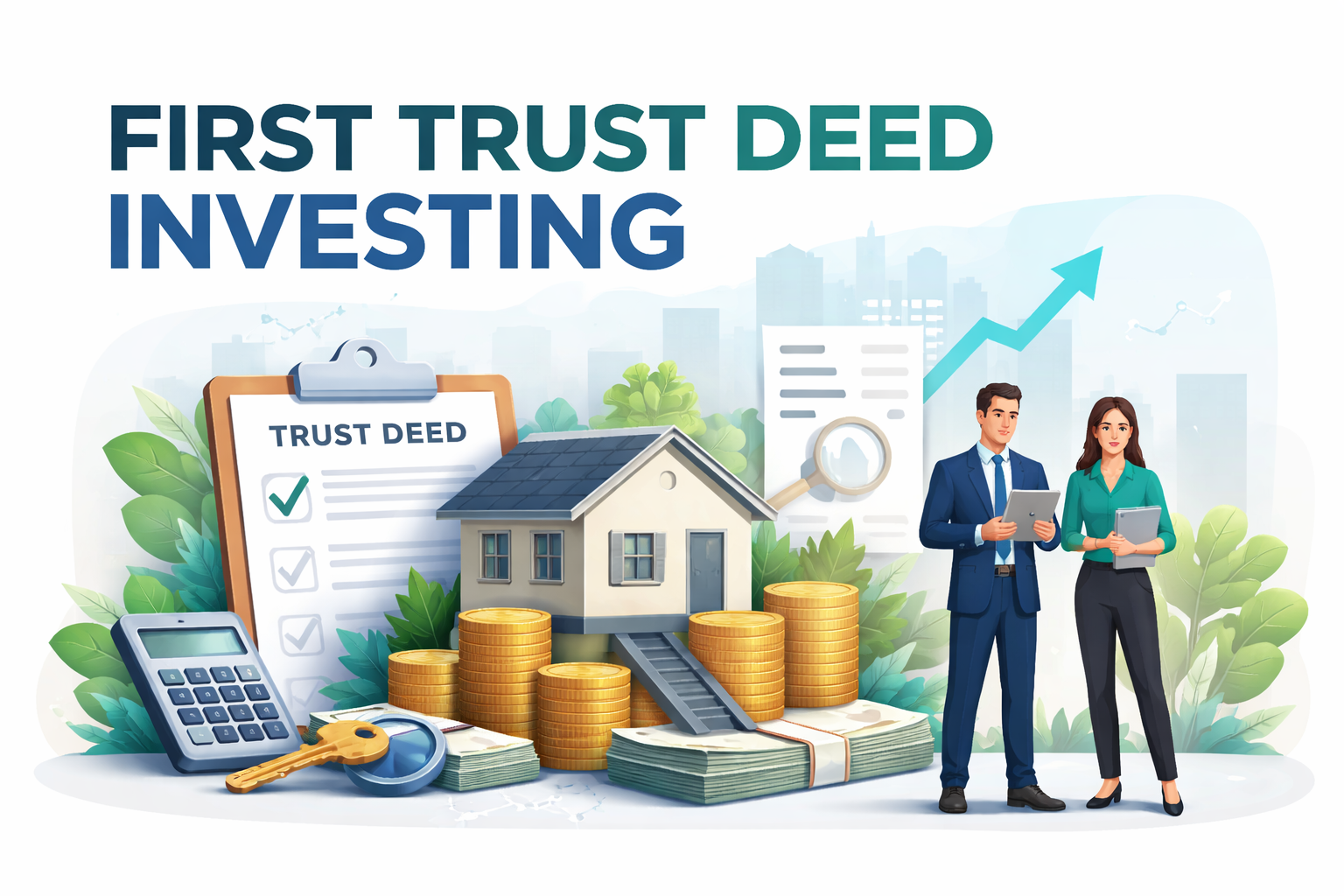
First trust deed investing is a real estate–backed lending strategy in which an investor funds a loan secured by property and holds the first lien position. This means the investor has primary legal rights to repayment before any junior lienholders if the borrower defaults.
In first trust deed investing, the loan is evidenced by a promissory note and secured by a deed of trust recorded against the property. The investor earns fixed interest payments while the property serves as collateral.
Definition of a First Trust Deed
A first trust deed is a security instrument used in many U.S. states that places a lien on real estate to secure repayment of a loan. It involves three parties:
- Borrower (Trustor) – Property owner receiving the loan
- Lender (Beneficiary) – Investor providing capital
- Trustee – Neutral third party holding legal title for security purposes
In first trust deed investing, the investor becomes the beneficiary and holds senior claim rights over the property.
Definition Snippet (Featured Snippet Optimized):
First trust deed investing is a form of private real estate lending where an investor funds a loan secured by property in first lien position, giving the investor priority repayment rights and the ability to initiate foreclosure if the borrower defaults.
First Lien Position Explained
Lien priority determines who gets paid first in foreclosure.
In first trust deed investing, the investor holds the senior lien, meaning:
- They are paid before second or junior lienholders
- They control foreclosure proceedings
- Their risk exposure is reduced compared to subordinate debt
Lien position is recorded publicly in county property records, establishing legal repayment hierarchy.
Why First Position Matters
- Reduces capital loss risk
- Improves recovery rate in foreclosure
- Provides stronger negotiating power
How It Differs From a Mortgage
Although similar in function, a deed of trust differs structurally from a traditional mortgage.
| Feature | First Trust Deed | Traditional Mortgage |
|---|---|---|
| Parties Involved | 3 (Borrower, Lender, Trustee) | 2 (Borrower, Lender) |
| Foreclosure Type | Often non-judicial (state dependent) | Often judicial |
| Investor Role | Private lender | Bank or institutional lender |
In states like California and Nevada, trust deeds are more common than mortgages due to streamlined foreclosure processes.
How First Trust Deed Investing Generates Returns
First trust deed investing generates income through:
- Fixed interest payments
- Origination points (in some cases)
- Short-term bridge loan structures
Returns typically depend on:
- Loan-to-Value (LTV) ratio
- Borrower credit profile
- Property type
- Market conditions
📌 Summary
First trust deed investing is a secured real estate lending strategy where investors fund loans in first lien position. The property acts as collateral, and the investor receives fixed interest payments while holding priority rights in case of borrower default.
🔎 Key Takeaways
- First trust deed investing involves secured private lending.
- Investors hold senior lien rights.
- Returns come from fixed interest payments.
- Risk exposure is tied to borrower default and property value.
- Lien priority significantly impacts capital protection.
Also read:https://capitallooms.com/raiffeisen-investment-nachhaltig-solid/
How First Trust Deed Investing Works
First trust deed investing functions as a structured private lending process in which an investor funds a real estate loan secured in first lien position. The investor receives interest payments while the property serves as collateral, reducing unsecured credit risk.
The process typically involves loan origination, underwriting, collateral evaluation, documentation, funding, servicing, and repayment or foreclosure if default occurs.
Loan Origination Process
In first trust deed investing, loans are commonly sourced through:
- Licensed mortgage brokers
- Private lending firms
- Direct borrower relationships
The broker evaluates:
- Borrower creditworthiness
- Property value
- Exit strategy (sale or refinance)
- Loan-to-Value (LTV) ratio
According to industry standards, conservative first trust deed investing often targets LTV ratios of 60%–70% to maintain equity protection.
Role of the Promissory Note
The promissory note is the borrower’s legal agreement to repay the loan under defined terms:
- Principal amount
- Interest rate
- Payment schedule
- Loan maturity date
- Default provisions
In first trust deed investing, this note creates the income stream, while the deed of trust secures the obligation with real property.
Collateral and Property Valuation
Collateral is the foundation of risk control in first trust deed investing.
Property valuation may involve:
- Independent appraisal
- Broker price opinion (BPO)
- Comparable sales analysis
Investors assess:
- Property condition
- Location market trends
- Liquidity potential
- Foreclosure resale value
The goal is to ensure that the underlying asset value sufficiently exceeds the loan amount.
Loan-to-Value (LTV) Ratios
LTV is a critical risk metric in first trust deed investing.
| LTV Range | Risk Profile | Investor Protection |
|---|---|---|
| 50–60% | Low | High equity cushion |
| 60–70% | Moderate | Acceptable protection |
| 70–75% | Higher | Reduced margin of safety |
Lower LTV ratios improve recovery potential if foreclosure becomes necessary.
Repayment Structure
First trust deed investing typically offers:
- Fixed interest rates
- Monthly interest-only payments
- Balloon payment at maturity (common in 6–24 month loans)
If the borrower repays as agreed, the investor receives principal plus interest. If default occurs, the investor may initiate foreclosure under state law.
🔄 Step-by-Step Overview
| Step | Action | Risk Control Mechanism |
|---|---|---|
| 1 | Loan sourcing | Broker license verification |
| 2 | Underwriting | Credit and income review |
| 3 | Property appraisal | Independent valuation |
| 4 | LTV analysis | Equity cushion review |
| 5 | Funding & recording | Legal lien documentation |
| 6 | Loan servicing | Payment monitoring |
📌 Summary
First trust deed investing works by funding a secured real estate loan in first lien position. Investors earn fixed interest income while relying on property collateral and conservative LTV ratios to manage downside risk.
🔎 Key Takeaways
- First trust deed investing follows a structured underwriting process.
- LTV ratio is the primary risk metric.
- Income is generated through fixed interest payments.
- Property collateral provides capital protection.
- Foreclosure rights exist if the borrower defaults.
Returns in First Trust Deed Investing
First trust deed investing generates returns primarily through fixed interest payments secured by real estate collateral. Because investors hold first lien position, income is structured as debt yield rather than equity appreciation.
Returns vary based on loan structure, borrower risk profile, property type, and Loan-to-Value (LTV) ratio.
Typical Interest Rate Ranges
In first trust deed investing, interest rates are generally higher than traditional bank mortgages due to:
- Shorter loan terms
- Non-owner-occupied properties
- Faster funding timelines
- Credit or documentation flexibility
Typical annual interest ranges:
| Loan Type | Interest Rate Range | Risk Profile |
|---|---|---|
| Low LTV (≤60%) | 6%–8% | Lower |
| Moderate LTV (60–70%) | 8%–10% | Moderate |
| Higher LTV (70–75%) | 10%–12% | Elevated |
Rates may increase for:
- Construction loans
- Bridge financing
- Borrowers with weaker credit
Fixed vs Variable Returns
Most first trust deed investing structures offer fixed-rate returns, meaning:
- Interest rate remains constant throughout the loan term
- Monthly payments are predictable
- Income modeling is straightforward
Variable-rate structures are less common in private trust deed lending but may occur when tied to benchmark rates.
Fixed returns appeal to income-focused investors seeking stable cash flow rather than market-linked volatility.
Risk-Adjusted Yield
Return evaluation in first trust deed investing should consider risk-adjusted yield rather than headline interest rate alone.
Key factors influencing effective yield:
- LTV ratio
- Property liquidity
- Borrower repayment history
- Loan term length
- Origination points (if included)
For example, a 9% loan at 65% LTV may present lower overall risk than a 12% loan at 75% LTV.
Investors often prioritize capital preservation over maximizing nominal yield.
Payment Frequency and Structure
First trust deed investing typically uses one of two structures:
- Interest-Only Monthly Payments
- Investor receives monthly interest
- Principal repaid at maturity (balloon payment)
- Interest Accrual (Paid at Maturity)
- No monthly payments
- Interest compounded and paid at loan payoff
Loan durations commonly range from 6 to 24 months, especially in bridge and transitional property financing.
Gross vs Net Returns
Investors should differentiate between:
- Gross interest rate – Stated loan rate
- Net yield – After servicing fees, broker fees, or fund management expenses
When investing through pooled trust deed funds, management fees may reduce effective yield.
📌 Summary
First trust deed investing generates fixed-income returns through interest payments secured by real estate in first lien position. Typical yields range from 6% to 12%, depending on LTV, borrower risk, and loan structure. Risk-adjusted analysis is essential for evaluating true return potential.
🔎 Key Takeaways
- Returns in first trust deed investing are primarily fixed interest-based.
- Typical annual yields range from 6%–12%.
- Lower LTV ratios generally reduce risk exposure.
- Most loans are short-term with balloon repayment structures.
- Net yield depends on fees and servicing costs.
Risks of First Trust Deed Investing
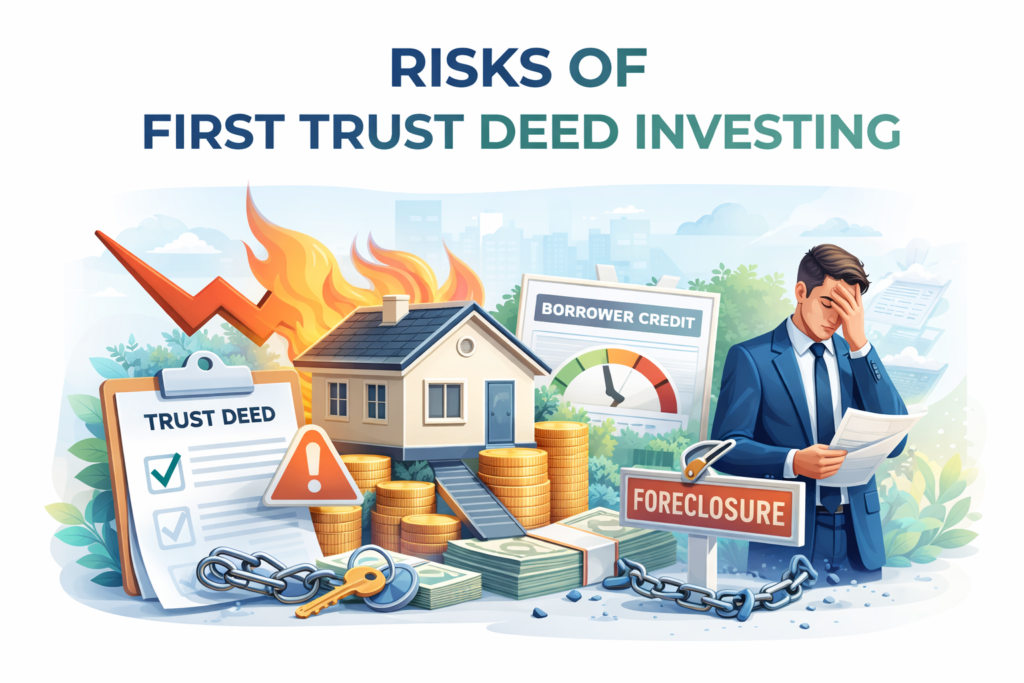
While first trust deed investing offers secured, fixed-income returns, it is not risk-free. Risk exposure primarily stems from borrower default, collateral valuation changes, liquidity constraints, and legal foreclosure timelines.
Understanding these risks is essential for evaluating whether first trust deed investing aligns with capital preservation and income objectives.
Borrower Default Risk
Default occurs when the borrower fails to make scheduled payments or repay principal at maturity.
In first trust deed investing, default risk is influenced by:
- Borrower credit profile
- Debt-to-Income (DTI) ratio
- Property cash flow (if income-producing)
- Exit strategy feasibility
Even with first lien protection, recovery depends on the property’s market value relative to the outstanding loan balance.
Foreclosure Timeline and Legal Risk
If default occurs, the investor may initiate foreclosure under state law.
Key risk factors include:
- Judicial vs non-judicial foreclosure process
- State-specific statutory timelines
- Legal costs and trustee fees
- Property holding and resale duration
Although first trust deed investing grants senior lien rights, foreclosure can take several months depending on jurisdiction.
Longer timelines increase:
- Carrying costs
- Opportunity cost
- Market exposure
Market Risk
Market risk refers to property value fluctuations caused by:
- Economic downturns
- Interest rate changes
- Local supply-demand imbalances
- Regional housing market declines
In first trust deed investing, declining property values can reduce the equity cushion protecting the investor.
For example:
- A loan at 70% LTV becomes riskier if property values fall 15%–20%.
Collateral protection depends heavily on conservative underwriting.
Liquidity Risk
First trust deed investing is generally illiquid.
Investors may face:
- Limited secondary market for selling notes
- Capital tied up until loan maturity
- Extended timelines if foreclosure occurs
Unlike publicly traded REITs, trust deed investments are not easily converted to cash before maturity.
Interest Rate Risk
Changes in broader interest rates can affect:
- Relative attractiveness of fixed-rate trust deeds
- Borrower refinancing ability
- Market demand for private lending
If rates rise significantly, existing fixed-rate notes may offer below-market yields.
Underwriting and Due Diligence Risk
Risk can increase if investors fail to:
- Verify property appraisal accuracy
- Confirm title insurance
- Review borrower financials
- Assess realistic exit strategy
Inadequate due diligence is one of the most common causes of capital loss in first trust deed investing.
📌 Summary
Risks in first trust deed investing include borrower default, foreclosure delays, declining property values, liquidity constraints, and underwriting errors. Although first lien position provides priority repayment rights, capital protection depends on conservative LTV ratios and thorough due diligence.
⚖ Pros and Cons
Pros
- Senior lien priority
- Real estate-backed collateral
- Predictable fixed income
Cons
- Illiquid investment
- Foreclosure complexity
- Market value sensitivity
- Borrower performance dependency
🔎 Key Takeaways
- First trust deed investing reduces but does not eliminate default risk.
- Conservative LTV ratios are critical for downside protection.
- Liquidity is limited compared to publicly traded investments.
- Foreclosure timelines vary by state.
- Thorough underwriting mitigates most preventable risks.
First Trust Deed Investing vs Other Real Estate Investments
First trust deed investing differs fundamentally from equity-based real estate strategies. Instead of owning property, the investor acts as a secured lender in first lien position and earns fixed interest income rather than rental cash flow or appreciation gains.
Understanding these structural differences helps clarify risk, return, liquidity, and control characteristics.
First Trust Deed Investing vs Rental Properties
Rental property investing involves direct property ownership and income generation through tenant rent payments. In contrast, first trust deed investing generates income from loan interest secured by the property.
| Feature | First Trust Deed Investing | Rental Property |
|---|---|---|
| Ownership | No property ownership | Direct ownership |
| Income Type | Fixed interest payments | Rental income |
| Management | Passive (loan servicing) | Active (tenant/property management) |
| Appreciation Exposure | Limited | Direct exposure |
| Risk Source | Borrower default | Vacancy, repairs, market cycles |
Key distinction: first trust deed investing prioritizes capital protection through lien rights, while rentals rely on operational performance and appreciation.
First Trust Deed Investing vs REITs
Real Estate Investment Trusts (REITs) are publicly traded or private entities that own income-producing real estate portfolios.
| Feature | First Trust Deed Investing | REIT |
|---|---|---|
| Structure | Private secured loan | Equity ownership in real estate portfolio |
| Return Type | Fixed interest | Dividends + market appreciation |
| Volatility | Low price fluctuation | Market-driven price volatility |
| Liquidity | Low | High (public REITs) |
| Correlation to Stock Market | Minimal | Moderate to high |
First trust deed investing typically offers more predictable income but less liquidity compared to publicly traded REITs.
First Trust Deed Investing vs Second Trust Deeds
Lien position significantly impacts risk.
| Feature | First Trust Deed | Second Trust Deed |
|---|---|---|
| Lien Priority | Senior | Junior |
| Foreclosure Control | Yes | Limited |
| Risk Level | Lower | Higher |
| Typical Yield | Moderate | Higher |
In foreclosure, first trust deed investing ensures repayment priority before junior lienholders receive funds. Second trust deed investors face greater loss risk if property value declines.
Risk and Return Comparison Summary
| Investment Type | Avg Yield Range | Risk Level | Liquidity | Capital Control |
|---|---|---|---|---|
| First Trust Deed Investing | 6%–12% | Moderate | Low | Secured lien |
| Rental Property | 4%–10% + appreciation | Moderate–High | Low | Direct ownership |
| Public REIT | 3%–8% dividend | Market-driven | High | No direct control |
| Second Trust Deed | 8%–14% | High | Low | Subordinate lien |
Returns must be evaluated relative to capital protection mechanisms and operational involvement.
📌 Summary
First trust deed investing is a debt-based strategy offering fixed income secured by real estate in first lien position. Compared to rentals and REITs, it provides lower operational responsibility and more predictable cash flow but reduced liquidity and limited appreciation exposure.
🔎 Key Takeaways
- First trust deed investing generates fixed income, not rental profits.
- It offers stronger capital protection than second trust deeds.
- It is less liquid than publicly traded REITs.
- It involves less active management than rental properties.
- Risk-return profile sits between equity real estate and unsecured lending.
Who Should Consider First Trust Deed Investing?
First trust deed investing is generally suited for investors seeking fixed-income returns secured by real estate collateral rather than equity ownership or market-based appreciation. Because it involves private lending and limited liquidity, investor suitability depends on capital objectives, risk tolerance, and regulatory eligibility.
Accredited Investors
In many offerings, particularly private placements structured under Regulation D, first trust deed investing opportunities are limited to accredited investors as defined by the U.S. Securities and Exchange Commission.
Accredited status typically requires:
- Net worth exceeding $1 million (excluding primary residence), or
- Annual income above $200,000 individually ($300,000 jointly) for the past two years
Some direct trust deed investments may not require accreditation, but pooled funds commonly do.
Income-Focused Investors
First trust deed investing may appeal to individuals seeking:
- Predictable fixed interest payments
- Lower volatility compared to equities
- Structured repayment schedules
- Asset-backed security
Because most loans are fixed-rate and short-term, this strategy may align with investors prioritizing steady income over capital appreciation.
Portfolio Diversification Seekers
First trust deed investing can serve as a diversification tool within a broader portfolio.
Potential diversification characteristics:
- Lower correlation to stock market performance
- Real estate-backed collateral
- Debt-based return structure
Investors often use it to balance exposure between:
- Public equities
- Direct property ownership
- Alternative fixed-income instruments
Passive Real Estate Participants
Unlike rental ownership, first trust deed investing does not require:
- Tenant management
- Property maintenance
- Active operational oversight
Loan servicing is typically handled by a broker or servicing company, allowing for a more passive role.
Investors With Medium-Term Capital Availability
Because first trust deed investing is relatively illiquid, it may be appropriate for investors who:
- Do not require immediate access to capital
- Can commit funds for 6–24 months
- Understand foreclosure timelines may extend holding periods
Liquidity constraints should be considered before allocating significant capital.
📌 Summary
First trust deed investing is generally suitable for accredited, income-focused investors seeking fixed returns secured by real estate. It may benefit those prioritizing capital preservation, portfolio diversification, and passive participation, while accepting limited liquidity and borrower-dependent risk.
🔎 Key Takeaways
- Often structured for accredited investors.
- Designed for fixed-income objectives.
- Provides real estate-backed diversification.
- Requires tolerance for limited liquidity.
- Suitable for passive investment strategies.
How to Start First Trust Deed Investing
First trust deed investing begins with structured due diligence, proper sourcing, and conservative risk evaluation. Because the investor acts as a secured lender in first lien position, underwriting discipline and legal documentation review are critical before funding any loan.
The process typically involves broker selection, loan evaluation, documentation verification, funding, and servicing oversight.
1. Identify Licensed Mortgage Brokers or Direct Lenders
Most first trust deed investing opportunities are sourced through:
- State-licensed mortgage brokers
- Private lending firms
- Real estate investment groups
Before proceeding, investors should verify:
- Active state licensing
- Regulatory standing
- Complaint history
- Track record in first lien lending
Broker oversight may be subject to state financial regulatory agencies.
2. Review the Loan Package
A standard first trust deed investing package should include:
- Promissory note
- Deed of trust
- Property appraisal or valuation report
- Borrower financial summary
- Title insurance commitment
- Loan servicing agreement
Incomplete documentation increases legal and recovery risk.
3. Analyze Loan-to-Value (LTV)
LTV is the primary capital protection metric in first trust deed investing.
Conservative benchmarks:
| LTV Ratio | Risk Level | Capital Protection |
|---|---|---|
| ≤60% | Lower | Strong equity cushion |
| 60–70% | Moderate | Acceptable buffer |
| 70–75% | Elevated | Reduced margin |
Lower LTV improves recovery probability if foreclosure occurs.
4. Evaluate the Property and Exit Strategy
Key questions include:
- Is the property in a liquid market?
- What is the borrower’s planned exit (sale, refinance, construction completion)?
- Are comparable sales consistent with the appraisal?
- What are estimated foreclosure and holding costs?
Exit strategy feasibility directly impacts repayment likelihood.
5. Confirm Legal and Title Protections
Before funding:
- Ensure first lien position is recorded
- Confirm clear title through title insurance
- Review foreclosure procedures in the relevant state
- Understand trustee responsibilities
Proper lien recording establishes legal priority in first trust deed investing.
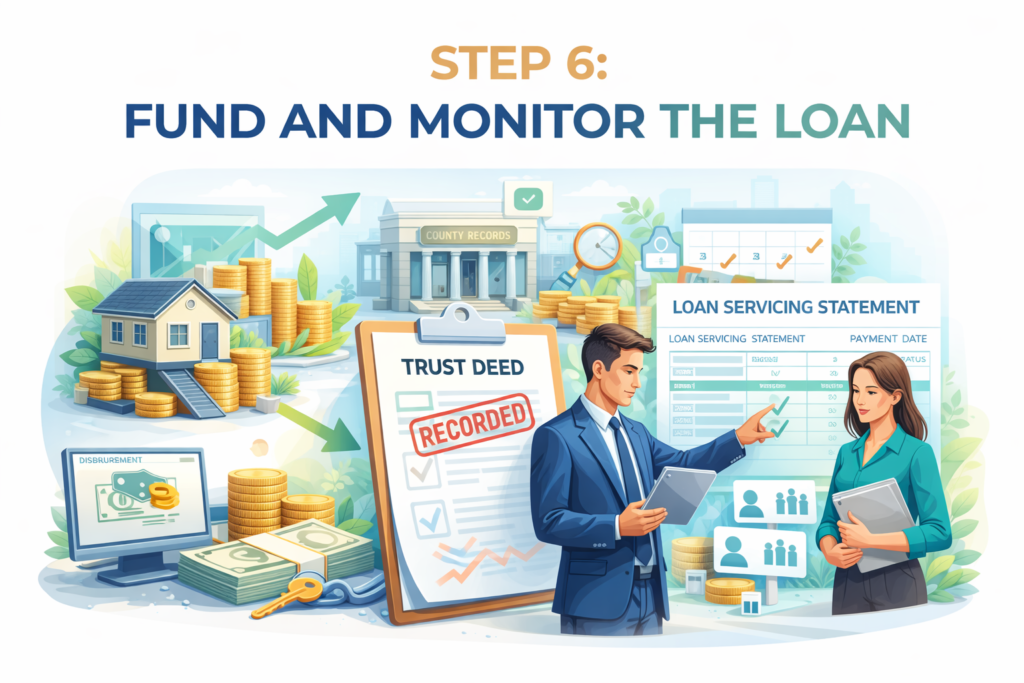
6. Fund and Monitor the Loan
After execution:
- Funds are disbursed
- Deed of trust is recorded with the county
- Loan servicing begins
- Monthly payments are tracked
Investors should receive periodic servicing statements confirming payment status.
📌 Step-by-Step Overview
| Step | Action | Purpose |
|---|---|---|
| 1 | Broker verification | Regulatory protection |
| 2 | Document review | Legal security |
| 3 | LTV analysis | Risk control |
| 4 | Property evaluation | Collateral assessment |
| 5 | Title confirmation | Lien priority |
| 6 | Servicing oversight | Income monitoring |
📌 Summary
Starting first trust deed investing requires disciplined underwriting, conservative LTV analysis, thorough document review, and confirmation of first lien recording. Capital protection depends on proper broker selection, collateral evaluation, and ongoing loan servicing oversight.
🔎 Key Takeaways
- Verify broker licensing and regulatory compliance.
- Review complete loan documentation.
- Prioritize conservative LTV ratios.
- Confirm first lien position and title insurance.
- Monitor servicing throughout the loan term.
Common Mistakes in First Trust Deed Investing
Although first trust deed investing provides senior lien protection and fixed-income structure, investor errors in underwriting, documentation, or risk assessment can significantly increase capital exposure. Most losses in first trust deed investing result from preventable due diligence failures rather than structural flaws in the instrument itself.
Ignoring Loan-to-Value (LTV) Discipline
One of the most common mistakes in first trust deed investing is prioritizing higher interest rates over conservative LTV ratios.
Risk implications of excessive LTV:
- Reduced equity cushion
- Higher probability of capital impairment during market declines
- Increased foreclosure loss severity
Industry practice often favors ≤65% LTV for stronger downside protection. A high-yield loan at 75% LTV may carry substantially more risk than a moderate-yield loan at 60% LTV.
Overlooking Borrower Creditworthiness
First trust deed investing is secured by property, but borrower behavior still matters.
Failure to evaluate:
- Credit history
- Debt obligations
- Income stability
- Prior real estate experience
can increase default probability. Collateral reduces risk but does not eliminate borrower performance risk.
Inadequate Property Valuation Review
Relying solely on borrower-provided valuations is a common underwriting mistake.
Proper due diligence should include:
- Independent appraisal review
- Comparable sales validation
- Market liquidity analysis
- Assessment of local economic conditions
Overestimated property values reduce effective collateral coverage.
Failing to Confirm First Lien Position
Investors in first trust deed investing must verify that the deed of trust is properly recorded in first position.
Risks of improper recording:
- Subordinate lien placement
- Legal disputes over priority
- Reduced foreclosure recovery
Title insurance confirmation is a standard protective measure.
Underestimating Foreclosure Costs and Timelines
Foreclosure is a legal process subject to state-specific rules. Investors sometimes underestimate:
- Legal fees
- Trustee fees
- Property maintenance costs
- Resale holding expenses
- Timeline delays
Extended foreclosure periods increase opportunity cost and market exposure.
Lack of Diversification
Allocating excessive capital into a single trust deed loan increases concentration risk.
Diversification strategies may include:
- Multiple properties
- Different geographic regions
- Varying borrower profiles
- Blended LTV exposure
Portfolio-level risk management strengthens first trust deed investing stability.
Chasing Yield Without Risk Adjustment
Higher interest rates often reflect:
- Elevated LTV
- Weaker borrower profile
- Transitional or distressed property
Effective first trust deed investing evaluates risk-adjusted return, not just nominal yield.
📌 Summary
Common mistakes in first trust deed investing include excessive LTV exposure, insufficient borrower screening, inaccurate property valuation, failure to verify lien priority, and underestimating foreclosure complexity. Conservative underwriting and disciplined due diligence significantly reduce preventable capital loss.
⚠ Common Misconceptions
- “First trust deed investing guarantees repayment.”
- “Collateral eliminates all risk.”
- “Higher yield always means better opportunity.”
- “Foreclosure ensures quick recovery.”
Each assumption overlooks practical underwriting and market realities.
🔎 Key Takeaways
- LTV discipline is central to capital protection.
- Borrower evaluation remains important despite collateral.
- Title verification confirms lien priority.
- Foreclosure can be time-consuming and costly.
- Diversification reduces concentration risk.
Conclusion
First trust deed investing is a real estate–secured lending strategy that provides fixed-income returns through first lien position collateral protection. By prioritizing conservative Loan-to-Value ratios, disciplined underwriting, and proper legal documentation, investors can structure predictable yield opportunities with defined risk parameters.
Unlike equity-based real estate strategies, first trust deed investing emphasizes capital preservation, income stability, and lien priority rather than appreciation potential. However, borrower performance, property valuation accuracy, liquidity limitations, and foreclosure timelines remain critical risk factors.
For investors seeking asset-backed income with moderate risk exposure, first trust deed investing can serve as a structured component within a diversified portfolio—provided that due diligence, regulatory compliance, and risk-adjusted analysis guide every funding decision.
Frequently Asked Questions (FAQs)
1. Is first trust deed investing safe?
First trust deed investing is considered more secure than unsecured lending because it is backed by real estate collateral in first lien position. However, it is not risk-free. Capital risk depends on Loan-to-Value (LTV), borrower credit quality, market conditions, and foreclosure timelines.
2. What returns can you expect from first trust deed investing?
Typical returns in first trust deed investing range from 6% to 12% annually, depending on LTV, borrower profile, loan term, and property type. Higher yields usually correspond to higher risk exposure. Net returns may be reduced by servicing or management fees.
3. What happens if the borrower defaults?
If a borrower defaults, the investor in first trust deed investing has the legal right to initiate foreclosure. Because the investor holds first lien position, they are paid before junior lienholders from foreclosure sale proceeds. Recovery depends on property value and outstanding loan balance.
4. How is a first trust deed different from a mortgage?
A first trust deed typically involves three parties (borrower, lender, trustee), while a traditional mortgage involves two (borrower and lender). In many states, trust deeds allow non-judicial foreclosure, which can be faster than mortgage foreclosure, depending on state law.
5. Do you have to be an accredited investor?
Some first trust deed investing opportunities—particularly pooled funds structured under Regulation D—require accredited investor status as defined by the U.S. Securities and Exchange Commission. Direct individual trust deed investments may have different eligibility requirements depending on jurisdiction.
6. Is first trust deed investing passive income?
First trust deed investing can function as a passive income strategy because loan servicing is typically handled by a broker or servicing company. Investors generally do not manage property operations but must perform due diligence before funding.
7. What is a typical Loan-to-Value ratio in first trust deed investing?
Conservative first trust deed investing commonly targets LTV ratios between 60% and 70%. Lower LTV provides a stronger equity cushion and improves capital protection in the event of foreclosure or property value decline.
References
- “How to Invest in First Trust Deeds: Benefits & Risks Explained,” Corporate lending overview on trust deed returns, margins of safety, and risk mitigation.
- “FAQ | Trust Deed Investing — ARIXA Capital,” detailed Q&A covering trust deed return expectations, LTV importance, and liquidity risk.
- “First Trust Deed Investing With Coastal Capital Group,” overview of expected returns, margin of safety, and how first trust deed positions work.
- “Benefits of First Trust Deed Investments,” high-level investment benefits, including yield ranges and risk mitigation through LTV ratios.
- “Trust Deed Investing: How to Earn Passive Income,” return profiles and risk factors for first vs second trust deeds.
- “First Trust Deed Investing Explained | Saint Investment,” practical explanation of first lien priority and legal differences versus mortgages.
- “First Trust Deed Investing Explained — Ignite Funding,” trust deed investing overview including parties involved, lien recording, and foreclosure structure.
- “What Is a Trust Deed? — Brooktree,” definition of first trust deeds and lien priority in property records.
- “What Is a First Trust Deed and How Does It Work? — Accounting Insights,” lien priority and repayment hierarchy explanation.
- “How Trust Deed Investments Work for Private Lenders — LegalClarity,” foreclosure process and default risk detail.
- “How Trust Deed Investors Evaluate Risk and Return — LegalClarity,” LTV, borrower assessment and lien priority risk fundamentals.